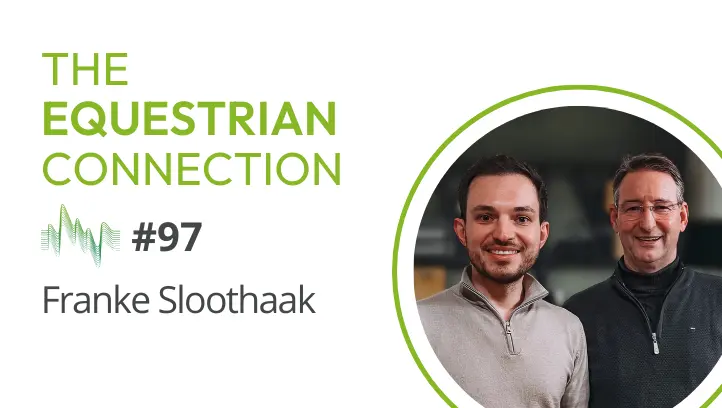
#97 Show jumping legend Franke Sloothaak: His life, his horses, his successes
Franke Sloothaak is a true legend of show jumping: During his active career, he became World Champion and Olympic gold medalist, winning numerous major prizes. He trained and competed in top-level competition with more horses than almost anyone else. Today, he works behind the scenes, coaching students all over the world.
In conversation with Christian Kroeber, he looks back on his career, recounting how he began teaching at the age of 15, how his time at Alwin Schockemöhle's stable shaped him, and his first appearances for the German team. What unites all the stages of his equestrian career is a keen eye for a horse's strengths and weaknesses. He discusses how seemingly minor details can be crucial and always returns to one key principle: His focus is on training horses in a way that promotes their health, improves their movement, and motivates them for long-term work with humans.
An inspiring conversation full of horsemanship, about Franke's personal journey, his will to win, and current challenges in the sport.
*Important to note: This podcast episode was originally recorded in German for the wehorse podcast. We used translation software to dub the episode for our English podcast, The Equestrian Connection.
Podcast Transcript
This transcript was created by an AI and has not been proofread.
[SPEAKER 3]
[00:00:01-00:00:05]
On this episode, we're speaking with show jumping legend, Franke Sloothaak.
[SPEAKER 1]
[00:00:07-00:00:21]
My constant belief is this. The better the horse is in its body and its movement, the longer it stays healthy. And that should essentially be the first principle for every rider. I must keep my horse healthy for a long time. And that's why the better a horse is in balance, the better a horse moves, the longer it stays healthy.
[SPEAKER 3]
[00:00:23-00:01:53]
Welcome to the Equestrian Connection podcast by WeHorse. My name is Danielle Crowell and I'm usually your host. However, on this episode, it was actually originally recorded in German for the WeHorse podcast hosted by WeHorse CEO Christian Kroeber. And then we use translation software to dub the episode so that our English viewers such as yourself can listen to it as well. Franke Sloothaak is a true legend of show jumping. During his active career, he became world champion and Olympic gold medalist, winning numerous major prizes. He trained and competed in top level competition with more horses than almost anyone else. And today he works behind the scenes, coaching students all over the world. In conversation with Christian Kroeber, he looks back on his career, recounting how he began teaching at the age of 15, how his time at Alwin Schockmöhle's stable shaped him, and his first appearances for the German team. What unites all the stages of his equestrian career is a keen eye for a horse's strengths and weaknesses, and he discusses how seemingly minor details can be crucial and always returns to one key principle. His focus is on training horses in a way that promotes their health, improves their movement, and motivates them for long-term work with humans. It's an inspiring conversation full of horsemanship about Franka's personal journey and his will to win and current challenges in the sport. All right, let's dive in.
[SPEAKER 2]
[00:01:53-00:01:55]
Hello, Franke.
[SPEAKER 1]
[00:01:56-00:01:56]
Hello.
[SPEAKER 2]
[00:01:56-00:01:58]
It's a real pleasure to have you here with us on the podcast.
[SPEAKER 1]
[00:01:59-00:01:60]
Yes, it's also nice to be here.
[SPEAKER 2]
[00:02:01-00:02:12]
We're sitting here with you in your kitchen. It's really cozy and comfortable. And a saying that's very often associated with you is, without a horse, I'm nothing but a pedestrian. How much of a pedestrian would you say you are these days?
[SPEAKER 1]
[00:02:13-00:05:38]
It hasn't gotten anymore. I still ride a lot and do a lot of training. Naturally, I'm often on foot during training as well. But I have, yeah, what I do, essentially, it's all about the people, especially young people. And in principle, it's for the sport. How can we improve the horses? How can we refine all these different aspects even further? How can we, in principle, make the handling the whole process so that we have easy access? And those are always super interesting stories because if everything runs perfectly, they don't call me. So there are always some small problems and there's always a little catch. And then, of course, it's even more interesting because you have to grapple with it. Sometimes I've done something somewhere and then at night I'm thinking, I'm pondering, man, what else could you possibly do there? Zaim, what else could you give me to take along with me? Or how could we, in principle, improve some things when I come back next time? That is, of course, super interesting, exciting. And if you then ultimately get some direction and improvement or also see it as a challenge, okay, how all these things progress. Or just as an example, if we begin the training and the next time the veterinarian has come and says, oh, wow, the horses are all moving so much better, then I will definitely know that we have done something right. And essentially, my main focus is usually on improving the horses. And if I then essentially take over from the rider and perhaps ride the horse for 10 or 15 minutes and it changes a lot already, then that's essentially a good direction. Because otherwise the horse wouldn't follow me and it wouldn't accept it like that. And for me, these are actually elements that your work or this motivation or even the impulses you get from a horse to improve your physical condition, to essentially also mentally participate and to give direction to the sport. That's naturally the beauty when you can empathize with that. It's naturally very specific and quite nitpicky. And that's essentially the whole point, because I am, from that standpoint, quite meticulous. When I'm training with Katrin Eckermann, for example, and I say, man, now a bit more straight again and stay a bit further back. What? She says, you're such a nitpicker. But these are all just parts of it. They belong. And that's perhaps a huge advantage that I notice many small details and they immediately catch my eye. This allows me to address these little points right away. And when I realized, OK, we're not really making progress this way, then still finding an option to take the horse on a double lunge or approach the training differently to then essentially get the horse back on track or essentially get the whole thing going again. Because I experience a lot when I want to change something with the horse and essentially want to address the whole thing, the movement, posture or anything else there. I always say actually the rider is the real jerk then because in principle, if the horse in its youth had received proper training and development, if it were physically perfect, if it possessed the balance to correctly carry the rider and the strength from its knees to maintain that entire posture, then it would be different. Then, of course, things would be considerably easier. But since we usually arrive at a later point or somehow the whole situation has already started to drift, when I then step in, I sometimes find myself needing to start all over again from the very beginning just to tackle the initial part so that I can then properly move on to address the next one.
[SPEAKER 2]
[00:05:39-00:05:46]
Do you see yourself as a true dedicated trainer? One really notices all this meticulous work and dedication involved with horses. Is that ultimately what truly fulfills you?
[SPEAKER 1]
[00:05:47-00:08:27]
I always find that I have, of course, over the years, ridden so many different horses. I think there are few who have ridden so many horses in their career. Also, this example, I have 29 where I've won International Grand Prix with 29 different horses. And these are, of course, all parts of it. Back then, whether it was with Albert Schocker-Müller or Paul Schocker-Müller, there were always many horses with problems or something. The times were different then, of course. They weren't the very best ones like they are now. The level was, of course, like still different, but she always had to think hard. What can I do here? What can I essentially set in motion to achieve an improvement? Because my nature is, of course, that when I go to a tournament, I want to win. I don't want to be a participant. That's sometimes how it is with some riders when they start with their training. For example, I was once with Wilhelm Grever. international dutch rider and nation's cup competitor and then i was with him and i said but wilhelm just helped me out i said come on so i was with him and said by wilhelm let's have a coffee first then we sat down at the table and i said wilhelm do you know what the worst thing about riding is or at the competition when you're a rider at the competition you know what the absolute worst thing is it's when you drive home and no one even realized you were there that's truly the worst you know when you never get a placement or anything like that and then there was this wonderful moment I was later at a competition in Leuven and had won the Grand Prix. So I went over and congratulated him. They already know I was here. But you always notice the beauty of it is that you realize how it's still essentially within him. And what I find so great about it is in principle, when you can get people to reflect or motivate them or essentially the fundamental thought, why do I go to a tournament? I certainly don't go there just to somehow participate. That is what I find truly great when, in principle, the whole experience really sticks with you. Or, for instance, when I was in Helsinki and I was also there as a coach and Malen Bayon was also present training in the mornings. And in Sweden for four years, I always gave courses twice a year in February, in April and in October. And then when you finally arrive at the tournament, you've been out for a whole year and you still see them working with their faras. You can tell that a large part of it still remains. And these are, of course, I think, wonderful aspects that the riders, even if you've lost sight of them or no longer have these contacts, that in principle, the fundamental idea of what I envision for how we should train the horses, that something like that truly sticks with them.
[SPEAKER 2]
[00:08:28-00:08:34]
You moved from your home country, the Netherlands, to Germany back then at 14, 18 years old.
[SPEAKER 1]
[00:08:36-00:08:52]
I was with her first in Holland. Of course, I joined and I competed five times in the European Junior Championships. When I was 15, I became Dutch champion for the first time. And by 15, I'd already done show jumping training at three different riding clubs.
[SPEAKER 2]
[00:08:54-00:10:08]
so you were already so young as a coach and try to teach that to people as well exactly yes it was certainly an advantage that i was also the dutch champion um and the other aspect too that in principle these specific components also um now one naturally wonders what exactly do you intend to do with all of this how is that even possible i always find it very positive when young people in principle trust others and are willing to support and help them and they can't do much wrong and the first thing i naturally did was in principle my own exercises all the things that happened to me i did the same with them i thought that can't be so bad and and from that you naturally develop a bit of a perspective on things and when you do the training how the people sit on the horse how in principle this balance is there how in principle the impulses are given you get a sense of that in principle from a young age this then allows you to challenge people in that direction Is that a talent that was simply bestowed upon you at birth, or is it something anyone can learn just like you did? Because if you mention starting at five years old, stepping into that coaching role for the very first time, that's truly incredibly early. If you were to look today and take a 15-year-old who rides and tell them to train others, some might be able to, but you've already developed an enormous depth from it. Is that what it is? Is that a talent?
[SPEAKER 1]
[00:10:09-00:11:18]
What exactly is talent? As I've always maintained, talent often leads to a certain laziness. Talent alone is nothing yet. That's why talent, what I always say, is ultimately character. It's about your attitude, your mindset. That's essentially what you have. In the end, it's all about what you actually do with it. And of course, Bismillah, that was in my youth. It was like this. I was at our club and we had the strongest club at that time because... Essentially, we all trained together. If something wasn't working, I'd take the horses for a week and then the others could ride them again. And if the girls' horses became a bit insecure, I would jump them again for a while to give them confidence. So from childhood, this has essentially always been my path. If something didn't work, they always asked me. But from childhood on, in that regard, little has changed. It's naturally like that. Through the experience, through the countless horses you've had, it's greatly enriched your wealth of experience. And how do you deal with situations? What do you do then? It certainly has. That has helped immensely.
[SPEAKER 2]
[00:11:19-00:11:23]
What was your first contact with equestrianism? How did you get involved with horses?
[SPEAKER 1]
[00:11:24-00:13:40]
it's also a bit amusing uh actually um as a child this was what truly motivated me is at that time we worked with uh friesian horses and they still do you're from heron fen you see that is friesland friesland and there of course whenever the grass was mowed the pastures were mowed when essentially the hay was made and everything was turned and everything was pushed together They did. Back then, everything was done only with horses. And as a child, you'd naturally just run along with them, even when the armies were there, just following everything, like the horses with their foals just going along. And then this family where I always used to go, which of course sometimes happened in summer when school started, it was to the left. And then I'd sometimes take the wrong turn. it's all happened before but that's basically how it is and then there was this one memory or a part of it with horses um then the hay had to be we had a pretty flat wagon and the hay was pulled onto it a rope was tied around the hay pile and the horses basically had to pull it onto this wagon and since it had rained a bit it was a little damp and all that and that was an experience you never forget um then the horses were harnessed and they were meant to go without any doubt they got down on their knees to pull this hay onto the wagon you can't even imagine it okay at that time you had the pictures or something but if a horse leans into the harness like that basically to pull it without the farmer basically having done anything for it But this attitude, and for me, that was essentially this incredible generosity that horses inherently possess. How a horse, if you present or do things correctly for them, how they always go along, always towards the positive, that they are ready to be with us again. There's no rider who doesn't make mistakes. And there are, even when you start riding or someone wants to learn something, you just make so many mistakes. But if you say, okay, come on, screw it. The fundamental problem, which I believe we have, is something you notice today, I think, even in schools or kindergartens or just generally, that these children, in principle, have to say sorry, but not with the true understanding or weight of an apology. They just blurt out sorry and then immediately run off again. And it was the same for us, too. We make mistakes, but we can also apologize to the horse and say, man, damn it, we really messed up. We won't do that anymore.
[SPEAKER 2]
[00:13:41-00:13:44]
Ultimately, we learn from it. If so, there's something we must unlearn.
[SPEAKER 1]
[00:13:44-00:14:01]
But then you also always have to have the maturity in principle to say, okay, that was too much or too little or what. Somewhere it was wrong that you have to address the whole thing and say, man, we must do better. We must approach it differently. And then I find it great in principle that the horse's willingness, that they always go along.
[SPEAKER 2]
[00:14:02-00:14:07]
And then, at a very young age, you went to Germany, to Alwin Schokemuller's stable.
[SPEAKER 1]
[00:14:07-00:16:29]
So, by that time, I hadn't really learned anything. I only had my driver's license and my swimming badge. Well, it's better than nothing. And then it was the case that when I was 18, I basically wanted to become a riding instructor in Holland. And in Holland, there are three levels, you see, assistant, now commander, assistant, instructor. And that was my first year as commander. And the examination was scheduled then, which always fell in April. And I had several training courses. My courses always ran until April. And then in January, we were with Alvin Schockemoeller because Emil Hendricks had been there before. And he wanted to go back home because he wanted to resume his trade with his father and so on. So they looked for someone for him. And then Johan Heinz called my parents to ask if I'd like to work for Alwin. And that's basically how it happened. And I always wanted to learn more, even though my business, the way I ran it in Holland was already really good as a 15, 16 year old. So with the earnings and everything, that was all good. But I said, no, I want to get ahead in my sport. And that's essentially why I did these things. I then started working for Albin as an 18 year old. At that time, I was working alongside Hans Quellen, who unfortunately passed away last year. And of course, in my first year there, I only rode five year old horses, only presented young horses and took them to competitions. And basically that was the last year I actually competed for Holland in the European Championship. And I rode a five-year-old horse at that place, which actually had already won 10 MA competitions nationally here. And if you say today, okay, five-year-olds or something, but this horse was essentially also, I then placed second with that five-year-old at the European Championship. Precocious. riding precociously yes and then of course there was this time with alwin and in the second year i wrote my first competition and that year i won 11 times and then immediately received the golden badge in the same year and so um it's actually like that yes without thinking too much about it but quite successfully from childhood on always like that the whole thing without I never really thought about it myself but it just worked and it was fine and no matter which horse I rode the European Championships five times in the juniors and every year I had a different horse because they were gone again sold or something else happened and then okay new ones came.
[SPEAKER 2]
[00:16:30-00:16:39]
Was that looking back the most important turning point for you going to Germany to a stable with so many other horses where every day was a little different right?
[SPEAKER 1]
[00:16:39-00:17:42]
The slightly regrettable thing was that precisely in that year, that that was the year Alwin Shokumula became Olympic champion in Montreal. And then in the run-up, he basically didn't ride enough because Warwick didn't have any problems yet. And of course, that afterwards, he stopped riding and actually wasn't really in the stable anymore or hardly ever. And I only partially got to experience his horsemanship or riding. But I would have loved to have more of it because he was incredible in how he worked his horses, how he rode them in dressage. And that was amazing. That was unbelievable. And that was so beautiful again. He was, for example, again, a real enthusiast for Bobby Gunther. And Bobby Junter, in principle, Herbert Rehbein back then also learned from Bobby Junter. And that's why this constellation with Grunold Hoff, with Shufro and so on, all of that was, of course, an experience for me where you say, OK, getting to know that or being part of it was also important. Yes, something very special.
[SPEAKER 2]
[00:17:42-00:17:47]
How did things progress for you after that? So did you spend some time with Alwin Schokkemoeller? What was your next step then?
[SPEAKER 1]
[00:17:48-00:18:07]
Right. Okay. No. Yeah. Okay. I've essentially reached that point now. And then what happened was at that particular time, Alwin Schokkemoeller became the national coach. And of course, with my Dutch passport and I had Alwin's horses, I was supposed to ride them for the Dutch team. It was just then that I was considering the Olympics Moscow, which ultimately didn't take place.
[SPEAKER 2]
[00:18:07-00:18:10]
That was the boycott as part of the Cold War.
[SPEAKER 1]
[00:18:10-00:18:30]
It was the boycott. And then somewhere he said for him it was naturally difficult to provide the Dutch team with horses and to manage the whole situation, how it would proceed. So we sat down together and he said, you know, San, if you're good enough, it really doesn't matter which country you ride for. If you're not quite good enough, then it really doesn't matter because where you earn your money, that's also perfectly acceptable.
[SPEAKER 2]
[00:18:30-00:18:42]
And that's why in principle on the 22nd of December 1979, I became a German citizen because But that wasn't even possible back then, just like that. So you couldn't just say, I want to be a German citizen. That wasn't really a thing yet.
[SPEAKER 1]
[00:18:42-00:18:57]
Yeah, okay. Well, it was also, of course, the case that they already had a certain amount of interest in it. And then Dieter Graf Landsberg... The former FN president. Right. He essentially then initiated the entire process and really took charge of it. And then I was naturalized as a citizen in Beckham.
[SPEAKER 2]
[00:18:57-00:18:59]
Beckham, here in North Rhine-Westphalia.
[SPEAKER 1]
[00:18:59-00:19:00]
Right, yeah. I was naturalized there.
[SPEAKER 2]
[00:19:01-00:19:03]
And then it was said, Franka, he rides well. He should join our team. We'll give him a German passport.
[SPEAKER 1]
[00:19:03-00:19:14]
Right. Yeah, how they, I really didn't, I didn't know at all how it worked. They just said like, it's valid, I see, and they arranged everything. And then by a certain date, everything had to be ready and they got it all finished.
[SPEAKER 2]
[00:19:14-00:19:17]
And how did you tell that to the Dutch? They were also annoyed.
[SPEAKER 1]
[00:19:17-00:19:54]
Then the next thing, of course, a small problem arose. I had the fourth horse from Albert Schockemeulen with him. He became second at the German championship in 1980 in Munich with Argonaut. And then actually the whole thing also happened in Holland for the first time in Amsterdam. And then I, in Amsterdam, won the World Cup qualifier, the Grand Prix, the World Cup and the SB. And that was standard four times. And each time, of course, the German national anthem played. And then, of course, in Holland. And then essentially when everything is still so fresh, that was, of course, something where you say, hmm, that's...
[SPEAKER 2]
[00:19:55-00:19:56]
Provocation, actually, right?
[SPEAKER 1]
[00:19:57-00:20:17]
Yes, well, but they basically accepted it. And then, of course, everything just carried on. And that was but for me, it was naturally quite special standing there up front four times and hearing the anthem four times. One naturally had to get used to the whole thing a bit first.
[SPEAKER 2]
[00:20:18-00:20:30]
one of the most important tournaments in the Netherlands, Amsterdam, a top-tier event for the Dutch. But the association would have gladly taken you. You were probably also a candidate for the championship squad and so on.
[SPEAKER 1]
[00:20:31-00:21:09]
That was perhaps a small reason for it, because I was actually meant to join the team earlier. And that was precisely when Zangersheide was very prominent. Leon Melchior, he essentially had many riders, Johan Heinz and Harry Walter from Otterwey, Dick Wick and Willy van der Ham and Jan Broek. They all rode for Melchior's stable back then. And he essentially wanted the national, the team to also be from his own stable. And then naturally, there was no room for me in that. I was first on the team, but then at the very last moment, they replaced me again. They brought in someone else from Leon Melchior's table instead. That was also, of course, a bit of the reason in principle that made you think, come on, you'll just approach this whole thing differently.
[SPEAKER 2]
[00:21:11-00:21:20]
For you, it was one of the best decisions, quite a few successes, world champion, Olympic champion. In the end, in show jumping, you won absolutely everything there was to win.
[SPEAKER 1]
[00:21:21-00:22:21]
Well, that's, of course, what it's all about. You know, that's essentially the main reason you do the sport, that you actually manage to win this kind of challenge. It's really about the whole experience is also something for me, at least in a way that when I'm competing or doing anything else. It's not called show jumping for no reason. After all, it is, in fact, partly a show. We are essentially there to present something to the audience, to bring across excitement, to convey a sense of closeness and naturally to make these connections with the public, too. And I often had a huge advantage there that even when I was about to enter the course, I actually had no problem at all engaging in some lighthearted banter with the audience beforehand or doing something else. And that's also, these are all aspects of how you want to present the sport or the kind of development you envision. And essentially this fun factor that we all want to share, that's also crucial. Even though we're professionals or whatever, you want the sport, but the enjoyment must never be overlooked.
[SPEAKER 2]
[00:22:21-00:22:46]
And you also became quite a big fan favorite in Germany. You know, I believe many younger people, for example, wouldn't even know that you're actually originally Dutch. So many people aren't even aware of that necessarily, you know. And that's truly something quite special, especially considering the rivalry that existed between Germany and the Netherlands, which also partly existed in show jumping at the time that it developed in this manner.
[SPEAKER 1]
[00:22:47-00:23:07]
That was, I was, for example, when I was, how old was I? 14, 15. I once went with a friend of mine by train to Rotterdam for the Nations Cup. And that was quite an experience. Also, my friend and I were sitting in the stands watching the Nations Cup and Germany wins the Nations Cup. Then the national anthem plays and there are people next to us who didn't stand up.
[SPEAKER 2]
[00:23:08-00:23:09]
I nearly thought it'd be whistled.
[SPEAKER 1]
[00:23:09-00:23:30]
No, no, no. But then essentially we had, of course, gone through the war. And then you essentially realize how the whole thing, actually how everything unfolded. And Rotterdam, of course, was an especially extreme city where an immense amount was destroyed. And those are, of course, also these experiences that I believe simply also for life.
[SPEAKER 2]
[00:23:31-00:23:58]
it's wonderful to experience how in principle such different things uh what's all going on there and also to somewhat empathize with everything that has happened you can also see the deep-rooted connections that exist there can't you that in the end it's not just about which flag i'm competing for but in those specific moments during these grand sporting events there's so much history that plays a role which you truly feel in that very instant isn't there this Yes, but it's exactly the same.
[SPEAKER 1]
[00:23:58-00:24:36]
I do a lot. I've also taught a great deal in Japan and in Russia, in Finland, in Sweden. But the wonderful thing also in China is, of course, that this mentality or essentially the people, what is incredibly beautiful is to experience all these different cultures. Why are people fundamentally like this? Why is it that one says, OK, this inner attitude towards these people that one wants to get to know these different cultures and that fundamentally this interaction with these people, how is completely different.
[SPEAKER 2]
[00:24:38-00:24:60]
The time back then at Schockenmüller's was of course equestrian-wise probably the most formative period of your entire life. And above all, you rode there, among others, together with Ludger Birbaum too. You rode together, or rather you were both employed there as riders and trainers, which is already quite remarkable. Two true icons of show jumping who emerged simultaneously from that very same stable.
[SPEAKER 1]
[00:25:01-00:26:31]
Well, at that time, of course, I helped Lutscher a lot, especially if something wasn't working or if horses were a bit, then we did a lot together. And if something needed improving in Dresach, then I greatly helped him with that, too. And that's actually a really good thing to be able to say, OK, when you're part of a team and essentially work on these components together, because, as I say, alone is just alone. when you can naturally create synergies and basically do something like that together and support each other. Just watch how it is or help out here or can you take a look? That naturally helps, it enriches you. And of course, at that time, I was still young with Luger when you got there. And then, of course, he also learned a great deal from it and together we naturally achieved these successes at those tournaments. And perhaps sometimes you also need that collective spirit from the team, this sense that, yes, both of us, we both want to win. And then in principle, you take the incentives that you set for each other to essentially be right up there at the front. That supports, but it also makes you much, much stronger. Because the small details are incredibly important there. And it's when you can really work on it like that and tackle all those things together. That was a great time. It was truly the whole experience that we did a lot together. And yeah, that was something.
[SPEAKER 2]
[00:26:31-00:26:42]
How important is winning for you as a rider then, as a trainer now? Is that the ultimate validation or is the path really about constant improvement and the work you develop with the horse?
[SPEAKER 1]
[00:26:43-00:27:14]
No, I do think in principle that if you're organizing tournaments or competitions, you'll want to be among the best. That's the fundamental idea. For example, if I were to organize a tournament myself, there are definitely some riders I wouldn't invite at all because they're essentially just awful for the audience. They would, in principle, just spend the first few days riding around, checking things out, and maybe a little practice here, a little practice there. And their main objective is simply to go for the big prize. So I don't need riders like that.
[SPEAKER 2]
[00:27:15-00:27:57]
I want riders who every day, like John Whittaker or a Basti or someone like that, they compete daily like Hugo used to. every day or Richie so that people say okay that's why the audience comes to the tournament so they see it's a real competition not just the good riders basically riding around every day with nothing happening How do you perceive this current development that, generally speaking, the traditional tournaments, the major competition venues here in Europe are rather on the decline? If one now considers how many five-star events are taking place in the Gulf region, specifically the Persian Gulf, where riders compete before just 200 spectators or perhaps 500, how much does that perhaps sting you?
[SPEAKER 1]
[00:27:59-00:29:44]
It's true that people say, okay, but of course today we have different problems. That one thought, this thing, if I still think back to the first time I was in Aachen, someone gave her 10,000 D-marks. Today there's a million euros in the Grand Prix. The times have, of course, changed quite dramatically and that naturally has an impact on every rider or every stable. The costs have increased immensely. Everything has become significantly more expensive. Before you had one groom for 10, 15 horses. Now you need three. uh the trucks all the associated things tolls and everything as they say the operational costs they have tremendously increased just consider a veterinary and it's immense the additional expenses you essentially incur there and then of course the riders naturally make a plan for themselves considering where they can essentially earn their money this is no longer acceptable and i also think we're going to have problems so what do i mean by problems a championship should always be important that you say you want to go to the championship But still, some riders say, okay, I'll skip that because I essentially want to start my horse there. Try to stop a rider from competing with their horse when the Grand Prix is essentially happening in Aachen, when the championship is just four weeks later. then he'll definitely go for the big prize as well. Or Calgary because they essentially still have the opportunity in principle to secure an additional bonus or something of that nature. And that is you don't have to in principle want to talk it down, but it is also due in principle to the problem that we have, that the costs are so high. Now we've entered a competition. Every horse, if you're competing at a place like Riesenbeck, what does the stall cost? If you factor in the stall and entry fees, you're looking at 650, 700 euros per horse. Try to get that money back at a two-star show.
[SPEAKER 2]
[00:29:45-00:29:47]
And you haven't slept and you haven't eaten anything yet.
[SPEAKER 1]
[00:29:47-00:29:51]
So 70, 80% of the people basically go home with losses.
[SPEAKER 2]
[00:29:52-00:29:57]
Is show jumping still a popular sport like you experienced it back when you first started?
[SPEAKER 1]
[00:29:58-00:30:15]
Well, what does that mean? It has also changed quite dramatically in terms of the fact that we hardly have any school operations. How would you, in principle, back then in WESEMS, we offered horseback riding as a school sport. And essentially, the children who participated, they could, in principle, get a riding lesson for their class.
[SPEAKER 2]
[00:30:17-00:30:30]
I experienced that myself. I was there myself, I believe it was during fifth grade. At that time, the entire class, I could already ride back then, of course, but the whole class traveled to Fustenau and we rode horses there.
[SPEAKER 1]
[00:30:32-00:31:33]
But try to find a school system operating there now. You can't just go there with a school group and say, okay, come on, today we'll do an hour with the entire class. That's just not possible anymore. And these are some of the issues. And then, for example, in Wiesems, we first advertised it or arranged it so that they would get a prize. And then we had a discussion with the entire youth department because he told us we're trying to get young people essentially from school all the way to the horses. But there's simply no more space available. And we also gathered the entire youth department back then in Wiesems. We held an evening there and then we said, OK, look, it's just not going to work. We don't really manage in principle to allow children, even if we want many more to go that way. But there's no space. You basically don't get them at the beginning. And then we essentially changed the prices. Then they went to Egidane with all the buses and then they moved to other parts. We often had the final in Oldenburg, from which basically later a show segment and other things developed. But it eventually faded out again.
[SPEAKER 2]
[00:31:33-00:31:60]
But wasn't it also the case that you and many of your colleagues were more accessible? If you look at today's top athletes, they're today in Abu Dhabi for a tournament, tomorrow in Wellington, the day after tomorrow in Hong Kong. Hasn't the sport of show jumping also changed so much that this connection to the grassroots has simply in practice become so incredibly difficult given how things are because they're constantly traveling so much?
[SPEAKER 1]
[00:32:01-00:33:22]
That's a huge – it takes on a different form. It's a huge problem that these riders, how are they supposed to train a young horse? They won't even get to it. So that is already a big problem. So what about youth work? What can be done? And how can we essentially increase interest in young people more – Conversely, if you say, okay, I have a school horse now, how many hours must a school horse work to pay for itself? Or how much money do I essentially have to pay per hour so that I can keep such a horse? With the farrier, the vet, the stable, with all of it, the whole package, how much does it cost? How much? How? How does that even work? What's the price? How much are people then willing in principle to pay for that hour? And that's essentially the entire cost. You also need to have someone who supervises it, someone who provides the instruction, and those are also part of the expenses. Take a painter's apprentice, for example, they already earn 35 euros an hour. How is this supposed to function? How is this supposed to work? And those are things that cannot be undone. You can't turn them back. That's why there, too, the breeders have exactly the same problem that many of these regular small breeders basically all say, OK, it's not working anymore. The price is much too high. The vet costs and everything are such that it's just not worth it anymore. I can barely sell foals or I need special papers where you say, OK, where the demand is so low, where you say, OK, or an exceptional mare where you say, OK, that has won everything. But the others have a really hard time.
[SPEAKER 2]
[00:33:23-00:33:31]
From your perspective, and you coach an incredible number of active riders in top-level equestrian sports, from your perspective, what makes a good rider?
[SPEAKER 1]
[00:33:32-00:33:41]
Well, first of all, I think that in principle, the idea is I believe a truly good rider should be capable of training a young horse all the way up to Grand Prix.
[SPEAKER 2]
[00:33:42-00:33:44]
So down to a level of exactly one meter fifty five.
[SPEAKER 1]
[00:33:44-00:34:24]
So, yes. And if the rider can essentially build up a young horse, give it confidence, train it and get it into a physical condition so that it's properly developed over a few years and can perform, then you're a good rider. I'm not a good rider if I'm basically in Saudi Arabia and have the money and buy myself an expensive horse and say, OK, I can ride it. That has little to do with actual riding. Right. It's not that they ride badly. So, in principle, the better your horse is, the better you can, of course, make use of the whole thing. But essentially, a good rider should be able to train a horse themselves and somehow bring it all the way up to Grand Prix.
[SPEAKER 2]
[00:34:25-00:34:27]
What are the different facets that are truly required for that?
[SPEAKER 1]
[00:34:28-00:35:01]
First, the initial assessment of the horse and assessment of its conformation. How does the horse move? How active is it overall? Because today, various bloodlines naturally come with certain problems. Everyone in principle knows that and you have to recognize it. And what work, what things do I do with it to in principle allow the horse to develop further? My thesis has always been this. The better a horse is in its body and its movement, the longer it will remain healthy. And that should essentially be the first principle for every rider. I must keep my horse healthy for a long time.
[SPEAKER 2]
[00:35:01-00:35:02]
Healthy posture.
[SPEAKER 1]
[00:35:02-00:35:08]
The classic topic. So, and that is why, the better a horse is in its balance, the better a horse moves, the longer it will remain healthy.
[SPEAKER 2]
[00:35:09-00:35:15]
So first, the initial assessment, what kind of horse do I possess? What is its specific conformation? How should the training regimen then be designed for it?
[SPEAKER 1]
[00:35:15-00:36:41]
So, and that's, of course, sometimes really important. What's the interior like? Because if a horse has this willingness in principle, then many things become easier. But sometimes, of course, with horses, it's like this. We also have horses. I once had one myself. My horse wanted to be the boss. And I say for us, two bosses is difficult. And then you first need to have a confrontation. But if the horse is then convinced that one must be content with having just one boss, then perhaps you'll have another chance to really get the whole thing going and then actually achieve success again. But if the horse wants to be the boss... So, we must clarify the hierarchy situation. Yes, what else do we need to address? Basically, that you say, this is my spot and that's yours. what's normally necessary in nature for something like that. To have a horse, of course, you also need the... And for that, you naturally need to have the right circumstances, the opportunities regarding space, and also the proper conditions and care. And essentially, nowadays, it really requires a whole team. it's like a vet i don't want to need a vet if the horse is lame it gets treated i just want a veterinarian a supportive vet who when i'm essentially working with a horse and i say somewhere that it needs a bit of support a little help to improve itself that's where i essentially see the management coming in whether that's a physiotherapist or if it's someone else what people do today with acupuncture or other things that you can support that essentially to make the horse stronger and better How do you view these novel methods of data collection?
[SPEAKER 2]
[00:36:41-00:36:59]
We often have eventing riders here as well who speak about it before championships. Of course, eventing is a somewhat different sport because it's very much about gallop, gallop and frequency. But data collection simply didn't exist at all in your time. You felt it and then implemented things accordingly. But how do you see all these new novel approaches?
[SPEAKER 1]
[00:37:00-00:37:28]
You can make use of everything, and perhaps you should if you have the opportunity. But whether you truly need everything is a completely different matter. That's just the way it is. Take, for instance, our show Jumping Horses. If I ride these horses every single day, what percentage of their full performance capacity does the horse actually require? Much is there. What level? 1%. How much? How much does a horse have to perform? What does a horse perform?
[SPEAKER 2]
[00:37:28-00:37:29]
Yes, that's a good question.
[SPEAKER 1]
[00:37:29-00:37:30]
Exactly. Is that 20?
[SPEAKER 2]
[00:37:31-00:37:32]
No one will know in the end.
[SPEAKER 1]
[00:37:32-00:38:10]
Exactly. Is that 20%? Is it 30%? We believe that normally during training, we never exceed 3%. And what if 4%? Basically, we never manage to get someone to give just 60% of their performance. We can do so much more. We have other factors that play a role. He's a long shot and not quite good enough to make it around the bend. But we don't necessarily assume that he's always performing at his absolute peak. I can certainly assess the racehorse. The winner might not have given 100%, but the second one, he definitely gave his all. And we don't have that. Basically, we have completely different factors. And that's why it's also the case that you say, okay, this strain, that you say, okay, this horse has a combined score of 100%.
[SPEAKER 2]
[00:38:11-00:38:21]
When you look back now at your champion horses from the past, Jolly Co, Wildsar, King Hawaii Hawaii, what truly defined these horses? What was their unique quality compared to all the others?
[SPEAKER 1]
[00:38:22-00:39:16]
Well, first of all, it's about this willingness to go along with it. And basically, when you're in the jump off, things aren't always perfect, but still to go along and still try and do everything. And that's naturally also one horse by nature where you say, OK, one horse is easier, the other is more difficult. This one, for example, was great, okay, in terms of its quality, but it was a slow horse. So with this particular horse, you always had to take a little bit more risk to be just as fast as all the others. Jolly Cover, on the other hand, was naturally fast. Then you can remain much calmer because you know deep down that you are truly fast. And these are the various factors that essentially play a significant role, the deployment of the horse and essentially what you do with the horse, actually to be able to present the entire situation exactly as you envision it. And for that, you essentially need the right mindset and the horse to perform well in the jump off. In short, this means that if you are truly committed and the horse is with you and that only works if the horse has complete trust in you, otherwise you simply won't succeed.
[SPEAKER 2]
[00:39:17-00:39:46]
At what point or how early on do you truly sense that a particular horse is destined for something much greater? Because ultimately, there are an incredible number of horses where you'd say, yes, the raw potential is clearly there. But when that's combined with the right attitude and temperament, it's actually quite rare. And you can still see that even today if you consider what truly sets United Touch apart from all the other horses. At this level, for example, it's the attitude, yes, and so on and so forth, combined with the capability that the rider ultimately brings to the track.
[SPEAKER 1]
[00:39:47-00:39:48]
But how early?
[SPEAKER 2]
[00:39:48-00:39:49]
How do you recognize it?
[SPEAKER 1]
[00:39:49-00:40:30]
Recognition is a part, but usually the rider is responsible for how the horse turns out. And that's why the rider must understand the horse from within, essentially how to approach it and what kind of work or activity is truly best for it. What does the horse truly need to be able to tackle this whole endeavor? And that's also part of the assessment where you say, okay, a horse might have incredible potential. It can jump tremendously. But if the horse in principle... Let me give you another example now. It was also nice that I actually hold the record at 240 meters SP. My father was naturally very proud. And then in Holland, they did a little interview with him and he was just beaming with pride.
[SPEAKER 2]
[00:40:31-00:40:34]
But I think you'd still have that today, right? There was a record attempt to beat it.
[SPEAKER 1]
[00:40:35-00:41:24]
That's how it's been up until now. And it probably won't happen that way again, I don't think. But my father is sitting on the sofa and he's watching a video on TV as he puts this video on and then they appear. And my father laughs about it and says, hmm, he says, the horses that do that, they mustn't be too smart because then they just wouldn't do it. It's something like that. So again, that's also a part of this whole story. If you have a super cautious horse and an incredibly smart horse, then it won't do things like that. But if the horse is made for it or somehow the horse is like that and has this willingness, then that's completely different. And this, in principle, is the assessment of what I can do with the horse or in which area it has the potential to become the best. Do you miss competitive riding these days?
[SPEAKER 2]
[00:41:24-00:41:25]
No, because I have no horse.
[SPEAKER 1]
[00:41:26-00:41:47]
No, but that's how it is. And I know myself too well. I've had offers quite often before that my horse could compete in tournaments again just a little bit. And the comeback, yes, but the problem is I know myself. If I once have a good horse and, you know, the potential is there, then I'll be on the road every single week again. And I just don't want that anymore.
[SPEAKER 2]
[00:41:47-00:41:48]
What is holding you back from that?
[SPEAKER 1]
[00:41:49-00:42:31]
No, because I know myself. It's not that I wouldn't be able to participate, but I know myself. I'd get too caught up in it. I've sometimes, just for fun, ridden in tournaments in China and even won big prizes there with unfamiliar horses. But that's just how it is then. That's just for a weekend. But otherwise, I don't have much to do with them. That's naturally also, I know myself too well for that, where I say, okay, I don't want to be going to Doha now, then to Calgary, then here, being on the road every week like Daniel Duzer. It's incredible how that guy, that bird flies back and forth every week. No, I don't want that anymore.
[SPEAKER 2]
[00:42:32-00:42:55]
If one looks at it from the outside now, and many show jumping fans who also came into contact with the sport during your successful period, they see that, for example, a larger beer bomb is still very much present in the media today, right? That a Hugo Simon was a media presence, now, of course, less so due to his age. With you, one gets the feeling that you consciously say, I would actually prefer to step back.
[SPEAKER 1]
[00:42:56-00:42:59]
Is that observation right? No, what do you mean resign? I didn't quit. I didn't.
[SPEAKER 2]
[00:42:60-00:43:02]
So stepping back, meaning stepping out of the spotlight.
[SPEAKER 1]
[00:43:02-00:44:18]
I don't really need to. I don't have to. I don't need to present myself for anything. I have plenty to do as it is. Staying a bit under the radar is also good. I do so many things that are really fun. Also with the youth now with the Host Gebra Foundation or then with the Young Rider Academy. Eventually they all come back around. So eventually they're all back here. And that's actually quite nice. It's also a confirmation that the way you're doing things, you're doing something right. And that's satisfying. It's fun. And that's essentially what it's all about. When you can support and guide young people or even sports from a position of backing or from a slightly different angle. I've got a problem with Clip and Horse now they basically want the whole thing I'm only allowed 40 just 40 contacts per month that's way too little for me because basically if I look at all my students here and then with different horses then after 14 days my account is full and that's why they essentially have to themselves send me their own materials and because that's something I really cannot cope with that just won't fit properly You could easily say right now, I'll be the national coach for Saudi Arabia.
[SPEAKER 2]
[00:44:19-00:44:28]
I'll be the national coach for the United Arab Emirates or any other country that's currently rising and show jumping. There you could practically pick and choose. That's also theoretically a monetary question.
[SPEAKER 1]
[00:44:28-00:44:47]
I could have, but I simply didn't want to. I also wouldn't become a national team coach because I see myself much more in principle as a coach in these specific areas, what I'm doing now, as help, as support. And basically, this whole thing, that's completely sufficient for me. I don't need anything more.
[SPEAKER 2]
[00:44:47-00:44:52]
But you're still in the saddle much more often. At least when we met here earlier, you were always wearing your riding pants.
[SPEAKER 1]
[00:44:52-00:46:10]
Still today, actually almost every day. And I always say I can explain it to horses quicker than to people. That's another advantage here one that has essentially been with me since my youth that when I want to change something or I see that there are problems my assessment or what I then tackle means that things essentially follow my lead faster go along with it and change. And that, of course, is a strength on one hand, but it's also something beautiful that in principle you can change these movements or the processes or even things even today. I still jump. I jumped again today and yesterday, too. And so with jumping, you don't forget it. It's not like anything has changed. The jumps are still there. And so the riding out or whatever, the whole thing is still the same. And that will never change. And that's, for me, a part where I say I could do it every day. But the way I have it now is good for me. And when I later see that, when I've jumped the horses and all that, and I see them again later at the competition, something better has developed. And that makes me happy. And I really find joy in that. And then that's pretty much the whole thing. Yes, that's actually what I find beautiful. That's quite enough.
[SPEAKER 2]
[00:46:11-00:46:19]
When you take a moment to look back at all your achievements, like being an Olympic gold medalist, a world champion and winning so many other significant awards, does that truly fill you with a deep sense of pride?
[SPEAKER 1]
[00:46:21-00:48:21]
Yes, because I am. I've always seen myself primarily as wanting to bring the horse to a point where essentially the horse was more in the foreground than I was. And actually, you know, they talk about me, but I was much happier when I could accompany the horse, essentially helping the horse to victory. And there are little things like that. For example, I was once in Oslo for the World Cup and I had Ligirio, a really big horse, long neck and all. And I won the Grand Prix with this horse. All the other riders came up to me afterwards saying, we never expected you could win the Grand Prix like that with this horse. And from that, essentially, how this horse, because for me it was also a shy horse, came home and then stood in its stall. And suddenly you had a different horse because the horse itself became proud of it and essentially felt more affirmed itself in its presentation. It became a different horse. And that's what I find, in essence, as a writer. If I can guide that, you know, that he's actually so... Take, for example, someone like Daniel Deuce with Killer Queen, what he essentially achieved and accomplished with that horse. It certainly wasn't an easy horse, but still to have those synergies and essentially that feeling, how he managed the whole thing with the horse and then to get that consistency in there. That is, I find that for a rider, it gives them a truly great feeling. And that's not how it is. That's why I always find when I'm doing training, I say the rider isn't important. And for me, it's more about the horse. Then how does the rider, I say, how do I get him to move in such a way to improve the horse and for the horse to essentially have more joy and fun with it? And everyone knows that. Why do people go jogging? It's bad at first because it's never really pleasant at the beginning. But when they are used to it and do it every day, eventually, if they don't do it one day, they miss something. And from that in principle, a certain enthusiasm also develops that you can move things and somehow create a good feeling and just, you know, the whole experience. And that's essentially what I truly enjoy when the horses feel better afterwards. And then that they also know that their body, that there are more possibilities and that things can improve for them.
[SPEAKER 2]
[00:48:22-00:48:25]
Do you do any balancing activities? How do you switch off and relax?
[SPEAKER 1]
[00:48:26-00:48:35]
We'll go play a round of golf. That's the whole plan. And that's really nice too. Basically, my little boy, he also plays golf. He's also just started learning how to ride, but we'll just have to see how far he gets with it.
[SPEAKER 2]
[00:48:35-00:48:39]
We've just seen some initial videos here. And so their talent is truly undeniable.
[SPEAKER 1]
[00:48:40-00:53:04]
Okay, well, you know, it's hard to tell really. This is only the eighth team he's ever been on a horse, you know, but to debate that is already something that comes quite naturally to him. And that's something I really, really like. He has an incredibly good way with animals. That's true now with the dogs here or with other animals too. He immediately connects that. You can tell right away that the horses, when you go up to them and approach them, that it just works. That's simply the whole thing. And I believe that in life it also has a lot to do with energies, positive energies. I can't really be in an environment with bad energies or rather I just don't feel comfortable there. I don't need that, luckily. we can you know we can distance ourselves we can leave we can run away from it all and i think that's the main thing and and the horses feel that that's when i go to train or just when i arrive at the stable everything is immediately different simply because i myself actually approach things very positively never trying to say that's bad or that's not for me And you can tell it incredibly quickly from the horses, too. They know when they arrive, the horses are already different because basically they already know from your voice that something that you're saying, OK, that something is amiss. And that's actually also and I believe animals are much more sensitive than we are. They pick up much, much more than we think. And that's actually about these moments differently. pause to really take them apart and to think deeply about pause how horses essentially tick that's also what makes the whole thing but who's been post what makes it so special post this sensitivity this subtle nuance between things and post applying different stimuli i always say even when i'm teaching i always ask the girls i tell them uh in life we must create new incentives I also tell the girls, you're going to the club. Why do you wear makeup? Is it to attract attention? And that's just how life is, that we essentially always want to present ourselves a little bit and make a good impression, right? That's it. I also tell people, if you come to a tournament and you're in the warm-up ring and you see a horse that moves magnificently, then you only look at that horse. And when you make the first jumps now, moving over the jump, we basically always thrive on the fact that these movement sequences, they always captivate us, don't they? Or when you say, okay, I'm looking at the dance floor, which people do you watch on the dance floor? Those are always the ones that make the best impression. So by our very nature, we always have a certain enthusiasm for what presents itself better. And that's how it is. That's why this show or the presentation, everything happening here is also a part of our inner life, our energies and where we essentially find the most joy. And that's what I think is the whole point, that it allows you to stay true to yourself. And with this enthusiasm. And what else? If you don't have these essential components, then how can you possibly continue the training or how can you instill positive motivation and all of that into it? You only achieve that when you witness change or improvement in your movement or something similar. Do you watch any other sports? I love all sports. And really, it's also that sports are naturally quite varied, that you say, OK, I also find that when you watch gymnastics and see someone move incredibly or the whole thing, then or basketball, you just see the whole thing, how they move or even footballers. It's a little bit about movement. What's naturally an inherent temperament? When you watch a football game, there are immediately some players that just jump out at you because of their movement, their personal story, their tactics or some other whole package. The energies. What do you feel when you're watching? You can already tell. Where things are really going or what I sometimes also like to watch, what I enjoy watching now and then is snooker. This mastery of the ball and essentially bringing that ball exactly back to where you want it to be. This precision, the whole thing there, that's also again the sensitivity, the meticulousness or the pedantry, where then in principle this willingness to see these small details and to engage with them, that in principle I find excites me the most.
[SPEAKER 2]
[00:53:05-00:53:08]
In football, when Germany plays against Holland, who do you cheer for?
[SPEAKER 1]
[00:53:08-00:53:16]
I can only win. Exactly. That was essentially the whole thing when I was at the World Championship in The Hague and naturally also afterwards at the press conference.
[SPEAKER 2]
[00:53:16-00:53:18]
1994, when you became the world champion there.
[SPEAKER 1]
[00:53:18-00:53:36]
Then, of course, came the question, how do you feel? More Dutch, more German now? I say you can't be more Frisian. Yes. So there are always possibilities in principle to present yourself in the way you want or to do what you intend. There's always an opportunity. Sometimes, of course, you're tempted by certain things, but you have to be yourself and stand by what you do.
[SPEAKER 2]
[00:53:36-00:53:38]
Was that your greatest success?
[SPEAKER 1]
[00:53:38-00:55:21]
Well, I always think that's okay. I actually find it important that this kind of support that you... You're always being asked the question, what was your most important horse, or in principle, which horse did you love the most? And I must truly say that I was fortunate enough, essentially, in every single phase I was involved in, I had a fantastic horse down, starting with Albino, then I moved on to Rex and Robert, or later with Argonaut, and then with Farmer. Essentially, the entire journey then culminated in the 84 Olympics, or perhaps even beyond. Then the glory, it eventually began with Walser Koenig preparing for the subsequent Olympic Games. In between, Valido, who essentially won the European Championship, which was also nice later, was sold to Princess Helena, the daughter of the royal family. And afterwards, we met again. Last year in Aachen, we met up again and we reminisced about an old time when we were together at the disco with a few people there. well through sports of course and through all these other things we've already experienced so many interesting beautiful aspects and met people personalities and learned how to deal with them and the great the great thing is when you've achieved something in sports or accomplished a feat and you meet other people they show mutual respect and this makes it much easier in principle to converse with them I was good friends with Luciano Pavarotti, a wonderful person, just like the whole experience, being on the road with him in the car. But he truly rode a considerable distance away from him. It was also the thing that with Helmut Kohl, basically, at the tournament in Mannheim, we ate asparagus together at Peter Hoffman's. You know that whole part?
[SPEAKER 2]
[00:55:21-00:55:25]
And then he would always come personally and present the Federal Chancellor's Award.
[SPEAKER 1]
[00:55:25-00:55:53]
That's right. And then in the stable, we were together in the stable then, and I showed them my horses. And then I came to Corrado's box and said, oh, here, this is one of us. I said, he's a weight carrier. You know, you'll have to laugh too. No, but these are the fundamental components that, in essence, make up the entire situation. The fact that we are all just human beings and how we interact with one another. And for me, sometimes, especially today in our politics, the way people treat each other, that truly hurts.
[SPEAKER 2]
[00:55:54-00:55:56]
Is the respect you were just talking about missing?
[SPEAKER 1]
[00:55:56-00:56:28]
Yes, absolutely. And that's something where you'd say, OK, this mutual respect for one another, we really need that for the horses every single day. We have to. I always say we have to. We really need to be on equal footing. And it just can't be that one person feels comfortable up there and the other is down here. That's not right. We must, in principle, approach the level we want to achieve together responsibly. So we simply engage in the sport jointly and respect each other. Our interaction that we, in principle, handle the whole thing correctly. That is already very important in my eyes.
[SPEAKER 2]
[00:56:29-00:56:37]
Dear Franka, in our podcast, Bayons, we always have the four classic Rios questions. And the very first question is, do you have a motto that you live your life by?
[SPEAKER 1]
[00:56:38-00:56:46]
Yes, to be satisfied. And basically every single day, it's good to get up. That's basically how it is to have fun for the day.
[SPEAKER 2]
[00:56:47-00:56:54]
And now for our second question. If you had the opportunity to offer riders just one piece of advice concerning their interaction with their horses, what would that single piece of advice be?
[SPEAKER 1]
[00:56:55-00:57:02]
Learning to assist how the horse moves, what its body posture is like and how in principle you can actually improve that.
[SPEAKER 2]
[00:57:03-00:57:09]
Then question three. If there is one person who has particularly influenced you in your relationship with horses, who would that be?
[SPEAKER 1]
[00:57:11-00:57:16]
I can't answer that with just one person. In the past, of course, it was Alwin Schockermuller.
[SPEAKER 2]
[00:57:17-00:57:47]
uh because i truly valued his dressage work in akima the way he handled the sequences at the jump and all that he had a tremendous a huge part in it and and it must be said you approach the training very holistically so you do double lunch you really look beyond the obvious so it's not just pure flat work but it's truly a holistic approach in your method Yeah, because I also sometimes work with dressage horses and it's the same there too.
[SPEAKER 1]
[00:57:47-00:58:11]
For me, it's essentially about this movement, that particular rhythm where the horse essentially carries itself and then this expression you get, the positive aspect of getting the horse involved to participate. That's actually why it fits so well into the movement sequence for dressage or for jumping. I always say a show jumper can help a dressage rider better than a dressage rider can help a show jumper.
[SPEAKER 2]
[00:58:12-00:58:15]
And then to conclude, I'd like you to complete the sentence. Horses are for me.
[SPEAKER 1]
[00:58:17-00:58:31]
Horses are just like people. We all fundamentally have our own unique characteristics. We have our own problems, our own distinct personalities. And it is essentially that we must learn to deal with each other because we want to achieve something together.
[SPEAKER 2]
[00:58:32-00:58:34]
Dear Franke, thank you very much for your time.
[SPEAKER 3]
[00:58:36-00:59:10]
Thank you for listening to this episode of the Equestrian Connection podcast by WeHorse. If you enjoyed this episode, it would mean the world to us if you could leave us a rating and review as well as share us on social media. You can find us on Instagram at WeHorse underscore USA and check out our free seven day trial on WeHorse.com where you can access over 175 courses with top trainers from around the world in a variety of topics and disciplines. Until next time, be kind to yourself, your horses and others.