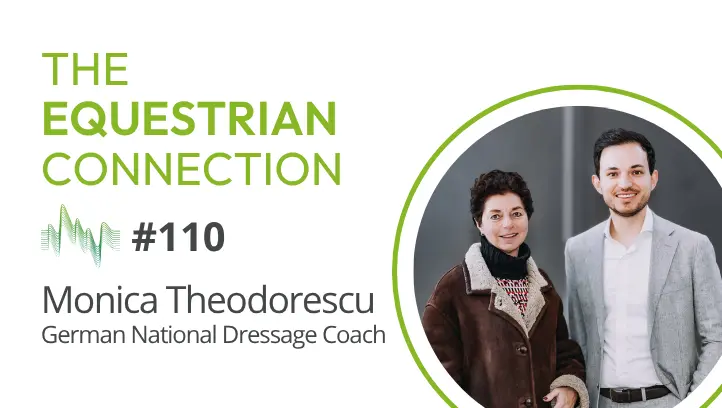
#110 What It Takes to Get to the Top with German National Dressage Coach, Monica Theodorescu
During her competitive career, Monica Theodorescu won three Olympic gold medals and claimed World and European Championship titles with the German team. She has served as the national dressage coach since 2012. For her, it is a dream job: although she sometimes misses competing herself, she finds it incredibly rewarding to work with the country's top riders and to guide young horses as they make their way into elite-level sport.
In this episode, Monica speaks with wehorse CEO, Christian Kroeber about her role as the German national coach, animal welfare in competitive sport, and how she successfully develops young talent to the level required for major championships.
*Please note: This episode is a translated episode from The wehorse Podcast, originally aired in July 2026.
Podcast Transcript
This transcript was created by an AI and has not been proofread.
[SPEAKER 1]
[00:00:01-00:00:06]
In this episode, we're talking with German national dressage coach, Monika Teodorescu.
[SPEAKER 2]
[00:00:07-00:00:22]
I really have a great job. I am lucky enough to be able to work with the best riders in the world and also with the best horses and to help develop the next best horses as well. And that is incredibly exciting, interesting and positive. You learn something every day.
[SPEAKER 1]
[00:00:23-00:01:19]
Welcome to the Equestrian Connection podcast from WeHorse. My name is Danielle Kroll and I'm usually your host. However, for this episode, we're giving you another one of our translated German episodes from the WeHorse podcast. During her competitive career, Monika Teodorescu won three Olympic gold medals and claimed world and European championship titles with the German team. She has served as the national dressage coach since 2012, and for her, it is a dream job. Although she sometimes misses competing herself, she finds it incredibly rewarding to work with the country's top riders and to guide young horses as they make their way into elite level sport. In this episode, Monica speaks with WeHorse CEO Christian Krober about her role as a German national coach, animal welfare and competitive sport, and how she successfully develops young talent to the level required for major championships. All right, let's get started. Enjoy.
[SPEAKER 3]
[00:01:20-00:01:21]
Hello, Monica Theodorescu.
[SPEAKER 2]
[00:01:21-00:01:23]
Yes, hello and good morning from New Münster.
[SPEAKER 3]
[00:01:24-00:01:36]
Yes, we are sitting here. If you look outside, there are 10 centimeters of snow that fell last night. There is a word. World Cup tournament here. You are here in your capacity as the national coach for dressage riders. What makes a good national coach?
[SPEAKER 2]
[00:01:37-00:02:49]
Well, I think first and foremost, like in all sports, I believe you are measured as a coach by success because we naturally need results that are on paper. And that means for us, of course, winning championships and also Olympic Games. Everything actually hinges on the Olympic Games every four years. That is our way of measuring time. And yes, we managed to win the last three Olympic Games with my presence and contribution as a team. And that is very, very important because a lot depends on it that is important for our federation. After that, the resources, meaning money, the funds, the resources from the federal government are calculated. That depends on the success of the Olympic Games. And that includes European championships and world championships. Actually not quite as highly weighted and not quite as decisive, but precisely the Olympic Games. And we were able to win the team gold medal in Rio in 2016 and also two individual medals, silver and bronze. And then in Tokyo 2021, team gold again, individual gold and individual silver. And the same thing again, albeit very narrowly, but the same thing again in Paris two years ago, a year and a half ago. And that is just very, very important for our sport and for our association as a whole.
[SPEAKER 3]
[00:02:50-00:03:08]
It's not transparent to many people that these funds, which come from this Olympic pot, that is, which are calculated based on the medals that in the end, every sports federation that... is attached to the National Olympic Committee, which is the DOSB in Germany, has an incredible amount at stake for a federation like the FN?
[SPEAKER 2]
[00:03:08-00:03:56]
Yes, exactly. The entire promotion of young talent also arises from this, from the funds that are earmarked for it. So that is a huge construct. It is, let's say, not just calculated based on Olympic medals, but also on how the entire federation is structured and how it operates and how these funds from the BMI, the Federal Ministry of the Interior, are calculated. But the medal hall or the medal corridor, as we always like to call it, is simply extremely important. And we are, well, we are certainly considered a niche sport. But we also contributed quite decisively to the overall medal tally in equestrian sports during the Games in Paris just two years ago. It really was a significant achievement for us.
[SPEAKER 3]
[00:03:56-00:04:06]
Very decisively. That was really in the press. It was really highlighted again that in the end, I don't want to say you pulled the chestnuts out of the fire, but the other athletes rather underperformed.
[SPEAKER 2]
[00:04:07-00:04:23]
Yes, well, that is actually the case, and I am pleased to say that we delivered on our goals in all three disciplines. It was a solid result, as they say. And that is simply incredibly important for our discipline, also for dressage and for equestrian sports as a whole.
[SPEAKER 3]
[00:04:23-00:04:44]
What does this cycle look like in concrete terms? So we are now two years away from LA, the next Olympic Games. say actually the cycle is decisive for you. Sure, there are European championships and world championships too. But what does this cycle look like in concrete terms? Does it begin the moment the last horse is out in Paris, actually already the path to the next Olympic Games?
[SPEAKER 2]
[00:04:44-00:05:30]
Almost, yes. So towards the end in Paris, my thoughts were already drifting a bit towards L.A. We talked about the location, the weather and the heat. I actually had that part at the very end because we were staying at a German house. Dennis Piler and I were sitting there comfortably, just kind of chilling. And then we were actually already talking a bit about L.A. And whether we need to go there earlier to acclimatize or not, whether we need a stable. And I said, well, we still have a bit of time. But that's precisely when the thoughts were actually already moving forward into the next cycle. And looking ahead, we have the end of February coming up in just 10 days, in fact, the very first webinar with the FEI, which is our World Federation, to discuss all the necessary information, schedules and other important details for LA.
[SPEAKER 3]
[00:05:31-00:05:36]
So there's basically a Zoom call, all the national coaches there, and then everyone gives a presentation.
[SPEAKER 2]
[00:05:37-00:05:49]
Yes, we'll find out. Coaches are invited, or rather every federation can then, whether it's the Secretary General or whoever else, whoever is responsible for it, or whoever wants to participate can then take part in the webinar.
[SPEAKER 3]
[00:05:50-00:06:13]
And to talk about this cycle again, sure, there are criteria now, like what's the weather like and how do we actually get there and so on. We had Frederick Wandress here on the podcast a few months ago. He explained how he plans his tournament calendar, for example, that he actually knows in January how the journey will go until December. Is that in the end a similar kind of planning to what a tournament rider does for the year, just over four years then?
[SPEAKER 2]
[00:06:13-00:07:12]
Yes, something like that. I mean, we naturally have a championship every year. This year, too, it's well known, a big one in Aachen. At the moment, the focus is entirely on Aachen and the World Championships. It's obviously something special to be in your own country, but it's actually like that every year. My planning starts from the championship and works backwards. So the championship is usually sometime in August, and then it goes backwards from there. What are the intervals between the tournaments and training camps? When, where, how long before, and so on. And that repeats itself, of course. It's also a certain routine every year. The German championships are in Balve. That is now a fixed location for us, and it actually always fits in terms of timing. And we have actually managed that very well every year. That is, of course, a routine process somewhere. But still, it always starts from the championship and works backwards. And when is the World Cup final? Is the World Cup final too close? To the tournaments that then start up again in the outdoor season, i.e. On the grass.
[SPEAKER 3]
[00:07:13-00:07:14]
That you always do in April, right?
[SPEAKER 2]
[00:07:15-00:07:55]
Usually it starts up again at the end of April in Hagen at Horses and Dreams. Yes, that's how you're already thinking about it. This year, the World Cup final is in Texas. Certainly no horses that would compete in the World Championships in Aachen will be starting there. At least that's not the plan so far. You never know, of course, but maybe one from the World Cup final will slip through afterwards or make a clean sweep. But basically, the horses that are in the Olympic squad and the riders who are preparing with their horses for the outdoor season and specifically for the World Championships or first the German Championships and then the World Championships do not have the World Cup final in Texas in their plans for those horses.
[SPEAKER 3]
[00:07:56-00:08:14]
Do all nations actually do it that way? Because in Germany, it's very, very focused where you say we are setting horses carefully with a clear plan towards the championship. But I could imagine now there are smaller nations that say, come on, we are happy that we have a rider at the World Cup final and we will take them along towards the World Championships as well.
[SPEAKER 2]
[00:08:14-00:08:35]
Yes, well, that is certainly possible. Or there might also be horses for which that is good. Or they say we might do it now towards the World Cup final. And the horse rider pair is so secure for the team that they might just take a break until the World Championships. But everyone has to decide that for themselves and every nation too. Decide for themselves what is best for whom and for which pair.
[SPEAKER 3]
[00:08:36-00:08:58]
Now for everyone who isn't so closely involved in tournament sports, why is it actually necessary to use them in such a measured way? Why do these breaks have to happen? If you look at soccer now, the good teams Borussia Dortmund plays every three days. Why is it that in horse riding there has to be this bigger plan behind it? When do I go where? How long is each break? Is it due to the individuality of the horses?
[SPEAKER 2]
[00:08:58-00:10:45]
Well, I mean, if you draw a comparison, And to soccer now, I can't judge that very well. But even there, there are players who have breaks. It's not always the same 11-11. So it's perhaps often, I don't know, some who play a lot or are very fit, but then eventually need a break too. And of course, let's say the welfare of the horse comes first anyway. Horses also need to regenerate and horses also need to recover in between and have light exercise. You don't always have to demand the tension and the performance like at a tournament. Instead, you just go for a casual ride in the countryside sometimes. Horses also go out to the pasture in between or more onto the paddock in winter, if that's possible at all. You always have to balance that out very well too. And there are horses that are fully trained, even at an advanced age. You don't have to constantly practice for tournaments with them. Instead, you... Spare them a bit so that they have their peak in the summer. But of course, the horses, even the older ones, they also need a certain rhythm. But just not every week or certainly not at that level. But they still need a tournament routine every now and then. And those that know it, the experienced horses, they like going to tournaments because then they are taken care of and pampered all day long. And they are the top priority. So they are fully in the focus of the whole team. And most tournament horses that do well, they are very well cared for and treated. And they like going to tournaments. When they see the truck or already know that the tournament trunk is being packed, Or I was just talking about it with Raphael Netz. So his camelot. who was just in third place in the Grand Prix, performed very well, but was also a bit nervous. He said they clipped him again last week. From then on, he knew it was time to go to a tournament again. So they know that exactly and they like doing it. They want to.
[SPEAKER 3]
[00:10:45-00:11:04]
A few weeks ago, Francis Luthak was sitting in your spot and he reported on a situation where he won the Grand Prix of Oslo. And he had the feeling that the horse was so proud and so happy to be able to win this Grand Prix. So it is, and we have to emphasize this again and again, especially in the tournament landscape. These horses enjoy doing it.
[SPEAKER 2]
[00:11:04-00:11:52]
Yes, when things are going well too. So they sense that and are really proud. And I mean, there are some that when you ride in, they are a bit shy. And oh God, now there are so many people. And can I do this? Will I make it? You encourage them and really give them confidence. And as a professional or as a rider, you should be able to sense that and also be able to encourage a horse that might still be a bit younger and shyer. And others, they come in and say, I'm here now, everyone look at me. And they come in with their chest puffed out somehow. And when horses have done well over the weekend, when things have gone well, they know it, they feel it, and they tell their colleagues at home about it too. That is really often to be observed. When they come home on Sundays or so, and then back into the stable, there's a commotion. And that is really great to experience.
[SPEAKER 3]
[00:11:53-00:12:00]
You have been the national coach since 2012, 14 years now. What drives you in this job? What do you enjoy most about this? job.
[SPEAKER 2]
[00:12:00-00:12:47]
Almost everything. No, well, I really have a great job or a great occupation. This motivation comes from the horses and the riders. I have the good fortune to be able to work with the best riders in the world and also with the best horses and to always help develop the next best horses as well. And that is incredibly exciting, interesting and positive. You learn every day and also the exchange with the riders, with their teams and with the grooms, with everything that goes along with it. That is totally my thing. I lived that way myself, always being in the stable with the horse as a rider. I've done that since I was a child and being a part of it and developing that. And when that eventually culminates in a great Grand Prix or a great freestyle, then honestly, there is nothing better.
[SPEAKER 3]
[00:12:48-00:13:06]
Looking back, was it difficult for you to step into that new role back then? Because it is quite different from being the one doing it yourself before. You are a three-time Olympic champion and can look back on an extremely successful riding career of your own. But the job of a national coach is something completely different, a complete change of roles. Was it easy to get into?
[SPEAKER 2]
[00:13:07-00:14:22]
Let's put it this way. It wasn't easy to stop with the sport. Getting into it wasn't that difficult, but not putting on the boots anymore, that was. And at the tournament, going straight to the stable, to the horse, that was the case for the first few years. I missed it a little bit. I really did miss that. And not the working together with the riders or standing on the sidelines. That is just as nice when you can contribute to it. There were, maybe there still are today, but especially in the first few years, really again and again, moments where I thought I would love to get in the saddle right now. I would really like to. But then you push that aside. But still, when you really take a step back and look at my life as a whole, it is, of course, a truly great continuation of being a fairly successful competitive athlete. And now I am finding ways to continue that success in this new chapter as well. And what I have learned along the way and also what I deeply learned in my younger formative years from my parents, especially from my father, has really shaped who I am today and how I approach everything. And to pass on the knowledge that I have received and learned from so many other riders and trainers is, of course, also a truly great task. It is a responsibility I take very seriously.
[SPEAKER 3]
[00:14:22-00:14:25]
Looking back, would you have liked to continue riding actively just as much?
[SPEAKER 2]
[00:14:26-00:14:51]
Yes, I would have. I would have. Well, let's put it this way. This position came to me, not the other way around. So it wasn't part of my life plan that I would have said at some point, well, I want to do that too, or that's where I want to end up. It happened the other way around. I mean, I was still riding in the Olympic squad in 2012. I was also still a reserve for London. So the request actually came a year earlier from our federation.
[SPEAKER 3]
[00:14:52-00:15:02]
How does that work then? Does the Secretary General or someone from the Federation call and say, hello, dear Monica, would you like to become the national coach? Coach? Or how does that work?
[SPEAKER 2]
[00:15:02-00:15:22]
Something like that. Well, there were a few conversations or various discussions, basically from the Federation side. Can we have a chat? And somehow it just happened little by little. It's also not something like that isn't just a quick chat decision. I mean, neither from the Federation nor from me, like I'll just apply. And if a position opens up, then I'd be ready.
[SPEAKER 3]
[00:15:22-00:15:23]
I would do it.
[SPEAKER 2]
[00:15:23-00:15:58]
That's not how it works at all. And it's also, let's say, not a position or a role where you just say, I'll give it a try and see what happens. And if it doesn't work out after a few months, well, there's just a huge responsibility involved. And there's a lot riding on it. So you really have to think it through. You have to think it over. At that time, I also still had a stable, a tournament stable and a training stable. I tried to keep that going for a few years as a training stable on a smaller scale, but then I gradually downsized it more and more. And at some point, we also sold to close the Lindenhof, my facility in...
[SPEAKER 3]
[00:15:58-00:16:00]
Near Wernau-Fugtorf, exactly.
[SPEAKER 2]
[00:16:00-00:16:25]
Fugtorf, that's right. We sold that too. I'm just traveling way too much and it didn't make sense anymore to try to maintain and manage a riding stable, a facility. It just wasn't possible at all. In any case, all of this was discussed and considered bit by bit in advance for some time. And I also did it together with my husband. He also has to be okay with it, that I am away quite a lot. And so far he is still...
[SPEAKER 3]
[00:16:25-00:16:27]
He's still on board? Yes.
[SPEAKER 2]
[00:16:27-00:16:29]
So far everything is still fine.
[SPEAKER 3]
[00:16:30-00:16:31]
Is this Olympic cycle secure?
[SPEAKER 2]
[00:16:31-00:16:57]
It is secured, yes, it is secured. But it is, of course, a different life, even though I was already traveling a lot to tournaments before. But then you are sometimes traveling together and not as much as now, where I am not only at the tournaments, but also constantly away in between with training courses and rider visits, meetings. And what else? I don't know. Everything. So it's not just 12 tournaments a year now.
[SPEAKER 3]
[00:16:57-00:17:00]
How many days a year are you on the road? Can you roughly estimate that?
[SPEAKER 2]
[00:17:01-00:17:03]
Well, I'd say it's a good 200.
[SPEAKER 3]
[00:17:03-00:17:05]
So actually just home to change suitcases?
[SPEAKER 2]
[00:17:05-00:17:09]
More often than not, I would have to say yes, that is definitely the case.
[SPEAKER 3]
[00:17:09-00:17:46]
When you back then, you just described that you were also in the Olympic squad before. London 2012, then the change into this new role. Do the colleagues accept something like that immediately and understand, okay, this is a longer process, this isn't something that happens ad hoc? Because it is indeed this different role that you just described. It's not just that you're suddenly standing on the sidelines, but in the end, you are also the decision maker for important championship squad spots, where ultimately every rider who is competing at that level wants to get to exactly that point. Is this change of roles also difficult, especially with regard to your colleagues? I imagine that to be particularly difficult.
[SPEAKER 2]
[00:17:46-00:18:40]
Yes, I mean, I didn't just slide into this completely new. I mean, I've known the dressage scene my whole life. And as a rider, I was also an active spokesperson on the dressage committee for many years. And as national coach, I don't decide anything. all by myself either. So, of course, I set a direction and also have many conversations about how I imagine things and how they could be if I see a development somewhere, a path that one can take. And I naturally discuss that internally with the members of the dressage committee. First and foremost, that is Klaus Roser as chairman of the dressage committee, who has also already has been doing it a bit longer than I have in this role. So when I was writing, that was already the case. And our team veterinarian, that has changed at times. But those are actually the people, along with my assistant coach, with whom I work very, very closely. And until a year ago, it was Johnny Hilbereth.
[SPEAKER 3]
[00:18:40-00:18:43]
Who unfortunately passed away then quite suddenly too.
[SPEAKER 2]
[00:18:43-00:19:33]
Yes, and we worked very closely together and constantly exchanged ideas so that one always, well, I always actively seek out the diverse opinions and unique perspectives of our entire team as well. Before we or I come to a decision. And we have very clear shared views as well as an attitude and mindset toward the sport regarding how we want to do things and how we want to see things, how we want to see things, how horses should be ridden, how training should be done, and how we want to present ourselves externally at tournaments and championships. And we work very, very closely together on that to keep the team, including the team around the team, together. And to keep everything nice and compact, including with the association staff. And I believe we have succeeded quite well in that over the last few years.
[SPEAKER 3]
[00:19:34-00:19:39]
How difficult was it for you that your co-trainer, Johnny Hilbrad, passed away relatively suddenly?
[SPEAKER 2]
[00:19:39-00:19:44]
Yes, that was, of course, a huge turning point. Well, I knew a little bit about the background.
[SPEAKER 3]
[00:19:44-00:19:46]
He's been ill for a while.
[SPEAKER 2]
[00:19:47-00:20:08]
Yes, he always had to take breaks, where he was then also alone at the tournament or looked after the riders alone. That was not a problem either. The end that it then took was still very, very sudden. We saw each other for the very last time at this tournament exactly one year ago. And that was very bitter. Also, personally, we had a very friendly relationship as well. That was also very sad.
[SPEAKER 3]
[00:20:09-00:20:15]
Well, as a national coach, you also sit together in the evenings. Beyond the professional and factual topics, you are also a closer team.
[SPEAKER 2]
[00:20:16-00:20:18]
Yes, we just have a lot of trips together.
[SPEAKER 3]
[00:20:18-00:20:20]
You traveled around the world. Yes.
[SPEAKER 2]
[00:20:20-00:20:49]
Well, the championships and Olympic Games. And yes, looking back, those were indeed many, many trips we took together over the years. And yes, we always got along remarkably well. That was never a problem for us. Yes, it was really quite a very friendly relationship. And it was always a good, truly trusting exchange between us, always from the very beginning to the end. It was a special time. What was confidential remained confidential.
[SPEAKER 3]
[00:20:49-00:20:53]
If you look now, you have a successor, Hendrik Lochtover. How do you choose a co-national coach?
[SPEAKER 2]
[00:20:54-00:22:54]
By trying, or perhaps I should say by not trying at all, to replace the other person exactly one-to-one. It is a delicate balance. But that's not possible at all. No, that's not possible. And I also think it's wrong. And everyone is different. Johnny was simply there for a very, very long time and everyone knew him. He was also very successful and well-trained and so on. That is completely beyond question. We were really a great team. I then also thought about it for a while and exchanged ideas with Klaus Rosa. It is really about the fact that someone should fully fulfill all the specific criteria required of a discipline coach or an assistant coach. And honestly, there just aren't that many people out there who truly fit the bill. Who can fulfill that. And of course, we also have to think a bit about the future, that it's not someone who is my age or even older, but rather someone younger, if possible. And well, I've known Henrik for a very long time, also his background from his family. From the Westphalian region. So Henrik has enjoyed a very good riding education, a very correct riding education. From his uncle Norbert Lochthof and later also completed his master's degree in horse management. Those are already very good prerequisites also as a trainer. He can also run a business and he knows what it means to be a professional rider. He has ridden in professional rider championships and has successfully trained horses and also ridden successfully in Aachen. And through several stages in his life, he was also in Switzerland, got to know a bit about another country and just brings a lot of experience with him. Henrik is just like me, not involved in horse trading, which I also think is very important. You are a trainer. Of course, a horse is sold or brokered here and there. But Johnny also kept that aspect very private within his professional riding business. And honestly, that level of involvement is actually also very limited when it comes to his work with Henrik. Because it is not good if you, as a trainer, also sell horses yourself.
[SPEAKER 3]
[00:22:54-00:22:56]
In the end, a clear conflict of interest.
[SPEAKER 2]
[00:22:56-00:22:57]
Yes.
[SPEAKER 3]
[00:22:57-00:22:59]
That would be the problem at the end of the day.
[SPEAKER 2]
[00:22:59-00:23:17]
Yes, that would be the case. And in that respect, it's not that easy to find the right person for it. And as I said, I've known Henrik for a long time and know that we get along well personally. And so he's just been getting a taste of the job now or since last year. But it's Henrik Lukhtov. And before that, it was Johnny Hilberath.
[SPEAKER 3]
[00:23:17-00:23:40]
You yourself, of course, have an enormous background in riding. Your father, George Theodorescu, competed for Romania at the Olympic Games in Stockholm and then used the Kio Arken at the end of the 50s to essentially flee the communist Stalinist regime in Romania and come here to Germany. Your mother, too, was a highly decorated rider. Was it always clear to you that you wanted to become a writer yourself?
[SPEAKER 2]
[00:23:41-00:23:54]
For me, yes. For me, it was totally clear. For my father, not quite so much. I mean, my father originally had the wish that I would become a pianist, and I had several years of piano lessons, and it wasn't even that embarrassing, perhaps.
[SPEAKER 3]
[00:23:55-00:23:56]
So you have a talent?
[SPEAKER 2]
[00:23:56-00:24:18]
Yes, well, the piano teacher always used to say, oh, if only. Only she had 10% of the motivation for me or for the piano that she has for the horses, the 100% or 200% that she has for the horses. But I gave that up at some point, of course. At some point we moved and the piano couldn't come along, or at least not right away. But I still have it today. I haven't really started again, but I actually still have it.
[SPEAKER 3]
[00:24:19-00:24:22]
So it's at home. You have it mothballed in the attic.
[SPEAKER 2]
[00:24:22-00:24:40]
No, it's at home. It's a piece of furniture in our house. There's also a nice piece of furniture with flower vases and things like that on it. But it's not really being used again yet. But I don't think I could bring myself to sell it. But maybe at some point it has to, maybe I'll get back on track again. But my father would have wanted that too.
[SPEAKER 3]
[00:24:41-00:24:46]
Well, you're still in a few Olympic cycles. Maybe after the last Olympic cycle, it just needs to be tuned again.
[SPEAKER 2]
[00:24:47-00:24:49]
Yes, then it will be tuned again. Absolutely, yes.
[SPEAKER 3]
[00:24:50-00:24:54]
But you are actually also a trained interpreter. But that was never a career option.
[SPEAKER 2]
[00:24:55-00:25:12]
No, not really. I mean, I do use the languages on the side, of course. I mean, even before I became national coach, I gave a lot of training courses abroad as well. And I still do that from time to time. And again, now when time permits and languages have actually always interested me. My father was also very keen on languages.
[SPEAKER 3]
[00:25:12-00:25:13]
Which languages do you speak?
[SPEAKER 2]
[00:25:14-00:25:17]
I speak English, French, Spanish, and we can manage Italian too.
[SPEAKER 3]
[00:25:17-00:25:21]
So really at a level where you could give a training course there in Italy?
[SPEAKER 2]
[00:25:21-00:25:56]
Yes, that's no problem. I mean, the language of riders and horses, I can do that better than for slightly more sophisticated conversation. I'd have to. read up on it first and practice a bit. But after a week, it would probably be fine. But about the writing lessons, because that was back in the day at the Lindenhof, there were many writers from dozens of different countries. And my father spoke all of that in the respective language. My father spoke perfect French and perfect Italian. And there were also many students from those countries there. I just picked it up like that. So it was just ingrained from the start.
[SPEAKER 3]
[00:25:57-00:26:00]
Where did it come from that he could still speak this foreign language so well?
[SPEAKER 2]
[00:26:01-00:26:20]
Well, first of all, I was also talented at it. And in Romania, or rather Bucharest back in the day, I was very Francophile. And my father had gone to a French school and spoke French just as well as Romanian, like his mother tongue. He only learned German later and English too later on. But the French was developed right from the start.
[SPEAKER 3]
[00:26:20-00:26:22]
Do you still have any connection to Romania?
[SPEAKER 2]
[00:26:22-00:26:36]
No, no. Did it also back then after the escape? There wasn't really any. I mean, I know that my parents used to send packages and money to Romania back then, but my father never went back there either because he had, after all, fled illegally, right?
[SPEAKER 3]
[00:26:36-00:26:42]
That was still before the time of the Iron Curtain, but in any case, that was a one-way street. That's a one-way ticket.
[SPEAKER 2]
[00:26:42-00:27:01]
Yes, well, there were also red lists, black lists, and so on. He actually never went back to Berlin either, not even to West Berlin. So not even until 1989. We had German championships there once or twice, or rather I did a few times. I rode in German championships in Berlin. He never came along. For that. He didn't fly either.
[SPEAKER 3]
[00:27:02-00:27:05]
Out of worry that if he flew over the Soviet sector, something might happen after all.
[SPEAKER 2]
[00:27:06-00:27:08]
Yes, well, that was just ingrained, yes.
[SPEAKER 3]
[00:27:08-00:27:13]
You were even honored with the Bambi Award back in 1992. It was quite an achievement.
[SPEAKER 2]
[00:27:13-00:27:18]
Okay, yes, that's right. But I don't remember if that was in 1992. Yes, could be, yes.
[SPEAKER 3]
[00:27:19-00:27:20]
And is that one also on the piano?
[SPEAKER 2]
[00:27:21-00:27:28]
No, it's with other Bambis. I almost said with other things on a very nice shelf where other honorary awards are also kept.
[SPEAKER 3]
[00:27:29-00:27:33]
Does that also show what kind of significance the successes of your career have?
[SPEAKER 2]
[00:27:33-00:27:57]
Yes, I suppose that just naturally comes along with it as well. Those are very beautiful experiences, very beautiful occasions. Also this honor award, or rather it was at that Bambi event in Cologne, I believe, back then. And there it was wonderful. He received Willie Milovich, already well over 80 at the time, the honorary Bambi, and I got to shake his hand. I mean, I was never really the cologne type.
[SPEAKER 3]
[00:27:58-00:28:00]
For all carnival enthusiasts, he is a demigod after all.
[SPEAKER 2]
[00:28:01-00:28:07]
Yes, well, he was a great personality, that man. So yes, those are the kinds of things you got to experience sometimes.
[SPEAKER 3]
[00:28:08-00:28:10]
Willie Milovic in Cologne at the Bambi Awards.
[SPEAKER 2]
[00:28:10-00:28:11]
Yes, tremendous.
[SPEAKER 3]
[00:28:11-00:28:24]
If you look at where Dressage Sport stands as of 2026, Germany is certainly a very hot contender for a gold medal now. By the way, your co-trainer said here in Neumünster yesterday that we want to become world champions. Do you agree with that?
[SPEAKER 2]
[00:28:25-00:28:38]
Yes, of course we want that. Yes, sure. If we didn't even want that, that would be bad to start with. No, in any case. Well, we are Olympic champions. We are European champions and we want to become world champions again. Of course, we want that.
[SPEAKER 3]
[00:28:38-00:28:59]
There has been a certain transition in the team now too. Jessica von Bredow-Werndl, for example, with her championship horse with Dallara no longer there. How do you manage such a transition as national coach? Do you already know beforehand, okay, I have to start building up the first ones again two or three years in advance or scout and see who you then bring along? How does that work?
[SPEAKER 2]
[00:29:00-00:29:42]
Yes, of course. Well, I keep an eye on everyone, not just the squad riders. I also keep an eye on other riders and, of course, their horses as well. And all the up-and-coming horses that are already competing at Grand Prix level or are entering Grand Prix sport. And we also have, of course, our structure and our series. The Nurnberger Bergpokal and the Louis D'Or Prize Series. The up-and-coming Grand Prix Series with the final. Just two months ago, back in Frankfurt, we were naturally keeping a close eye on all of them. Then we take a moment to see who is really standing out there this year and who is making a lasting impression. And I mean, we had a great one last year. Katerina Hemmer, who is a still young world championship rookie, I almost said.
[SPEAKER 3]
[00:29:43-00:29:43]
Newcomer.
[SPEAKER 2]
[00:29:44-00:31:17]
A newcomer to the sport or not to the sport, but at this level, she rode a great European championship. She almost had a bronze medal in the special with a great ride and also significantly contributed to the victory in the European championship, to the team victory. And so those are just. We have great young riders who already have a lot of experience in the Grand Prix. And Katerina had that too. She is a newcomer now, but she is not inexperienced. I mean, she is a professional rider. She has already brought various horses into Grand Prix sport and is implementing that fantastically as well. We are very well positioned there with very good younger riders who are coming up and also showing us great sport and great riding. What we never have enough of are top horses, but that's the case for others too. Of course, we have top horses and top trained horses, but back then in Rio, we had four horses that were scoring 80% and more. In the Grand Prix, that is truly amazing. That was truly extraordinary. I mean, at the same time, these four horses on one team and Cosmo was there for the first time with Sönke Rothenberger. Cosmo was still the youngest at nine years old back then. And that is, of course, truly an exceptional situation. You also have to realize that it's not the rule that 80% scores are just constantly being shown one after another or that these results are like that. That is really very special. And of course, it is quite a shame that we do not have Dallara in the sport anymore, competing with Jessica von Brito-Werndl. Unfortunately, she also lost her next top horse just about six weeks ago.
[SPEAKER 4]
[00:31:18-00:31:18]
Diallo.
[SPEAKER 2]
[00:31:18-00:31:22]
Diallo, who was already really quite settled in Stuttgart at that time.
[SPEAKER 4]
[00:31:23-00:31:24]
Which is incredibly tragic.
[SPEAKER 2]
[00:31:24-00:31:40]
Yes. He had high hopes and a great horse. And that was truly a very sad and tragic story. because it really highlights just how fragile things can be and how devastating it is to lose a top-tier horse so quickly. And you stand there and it just happens. Things like that happen too.
[SPEAKER 3]
[00:31:41-00:32:17]
A topic that has certainly accompanied you as national coach over the last few years is the topic of animal welfare. And the debates that are taking place around equestrian sports without now. I think this topic has already been covered and examined 500 times and looked at from all sides. But how do you, as national coach, view this complex of topics that we repeatedly find ourselves in a position where we have to explain ourselves? Because individual cases, be it in dressage or in other disciplines, keep causing us to be on the defensive regarding organized equestrian sports slash top level sports. What is your stance as national coach?
[SPEAKER 2]
[00:32:17-00:35:13]
Yes, well, one shouldn't actually have to explain oneself. And unfortunately, there are some individuals who are directly responsible for that situation. And they have massively damaged our reputation by circulating such incredibly negative and harmful images of us. That also has to be addressed. That is really important. And the debate as a whole, I find it very positive, or rather it helps us to continue to reflect, to question ourselves and to keep improving things. And a great, great deal has already improved in the sport. Of course, the entire approach to animal husbandry, horsekeeping has improved. There are guidelines and so on, which are also followed as best as possible. And it is, of course, also important that we in the sport, Do not point fingers at each other, but rather support one another in the measures to improve things. And not to sweep things under the rug? Absolutely not. If abuses come to light, then they must be addressed and penalized. And I find that incredibly important, even if one thinks, oh, God, something happened again. Unfortunately, that does exist. And perhaps not everyone is always quite there yet on the right track or, let's say, reflective enough to start changing things within themselves. Because I can't just say all animal rights activists are stupid. Or those who call themselves that or who also put their finger on the sore spot, they have a basis for that too. We do give them here and there bad images, and that shouldn't be. We really should try to change ourselves. I have to start with myself first and question myself. Am I always doing everything right? I certainly didn't always do everything right in the past either. And I was impatient at times too. And maybe I didn't get it technically right either or didn't really understand how I should do things. Do I do things differently today? I certainly do it better than before. And I also go, I believe we have always treated our horses quite well and also ensured they had turnout or also that they get outside. We did a lot of trail riding. I still do that today or have always done it. But still, you can always continue to improve the training and handling of the horse. And today we have such great talented horses that already bring so much with them from the start that you often have to hit the brakes and say, hey, slow down. Yes, it's already piaffing. It's already doing it. But slow down. Take your time. Let the horse grow. Let it grow into the tasks and so on. And I find it incredibly important that we, each of us in all areas, including tournament sports, keep listening to ourselves or reflecting on what we are doing. Is the music too loud in the arena? Is it too much commotion? Or can we make it a bit more moderate and give the horses more time? They also need a good night's rest to sleep. Wasn't it two years ago, for example, here, that there was a party in the arena at night on Saturday night? And it's great that people are having fun and can party. Unfortunately, the loudspeakers in the stables didn't turn off.
[SPEAKER 3]
[00:35:13-00:35:14]
Yes, that is rather suboptimal.
[SPEAKER 2]
[00:35:15-00:35:48]
There are so many things that come together there that we need to do better in order to do the right thing for horse welfare. Because, as we just said, horses like going to tournaments. And if they are also treated well and receive attention and affection, the horse is attentive to us. So I also give it affection and make sure it has the best possible care. And of course, we engage in competitive sports and also demand performance. But that must not come at any price. And my interests must actually always, not actually, must always take a backseat to the interests of the horse or the horse's well-being.
[SPEAKER 3]
[00:35:49-00:36:23]
But how can it be that some riders, and we are in the year 2026, still haven't understood that at big tournaments, every rider, without exception, has a role model function. And that in the end... Single wrong decision triggers something like an infection for everyone, because in the end, everyone is pilloried. That is always the somewhat unfair part at the end of the day. In my opinion, that an isolated case is then always projected onto everyone. But that is the media landscape we have. We have to deal with that, whether we want to or not. But that is actually, it's a shame, really. Perhaps it's actually terrible that it's still like that.
[SPEAKER 2]
[00:36:23-00:39:21]
Yes, I mean, it really feels like negative news simply spreads much faster than anything else. Or rather, it's always incredibly popular to read. And unfortunately, it is constantly being rehashed and recycled everywhere you look. We still see it today in some TV reports. Whenever there is a critical coverage of equestrian sports, it always appears again at the beginning in the trailer or in... And then that image from Tokyo of the modern pentathlete of the poor, desperate woman with the poor, desperate horse always comes up again. That gets rehashed over and over and is somehow seen as a bad example for all of us. And that is, of course, which is unrelated to dressage. That has absolutely nothing to do with dressage and is also unfair. It was simply a totally negative situation for everyone involved or for everyone who was involved there. And such images come out of desperation. Some critics, of course, make it easy for themselves. Or perhaps some media people too, simply by just rehashing this image, for example, over and over again, and showing it over and over again to generate an opinion somewhere among the the general public. That, of course, doesn't help us at all and is simply, in my opinion, poor style. But of course, we also have to deal with negative news and negative images. And that is simply important too, as you said. Everyone has a role model function. Everyone is called upon to ensure that this does not happen. There can always be situations where a horse is nervous or a horse gets startled somewhere and so on. And that was exactly as you started that we end up having to explain ourselves. When I know the horse and know the situation and know why the horse is reacting that way and the rider too. What is there? It's loud there. There is, I don't know what, bad air. There are a lot of people and horses are then simply a bit restless or feel disturbed or something like that. So, and if we work with the situation and get the horse used to it, that takes a little time. You can't just walk away and say, oh, it doesn't work anyway. No, no. You have to deal with it calmly. Calm the horse, work with the horse, get the horse, as we say, on the aids, meaning transitions, riding or whatever, until the horse trusts the rider. If it trusts the rider, then it will eventually trust the environment too. But it is very important to work on that and then also to explain it. And if the viewer also takes the time to follow that, the horse learns it and they have to learn it first too. And some are like fidgety children, a bit hyperactive, and others just find it all very relaxed. And cool. So every horse is different in that regard. And as a rider and also a trainer, you have to be able to deal with that and also communicate that to the outside world and also hold up a mirror to the riders here and there or to their home trainers or whoever it may be. I do experience it sometimes where people say, well, top level sport and all that, what they're doing is just not okay. I say, look at what you're doing yourself.
[SPEAKER 3]
[00:39:22-00:39:24]
It's also just too generalized.
[SPEAKER 2]
[00:39:24-00:39:50]
Yes, it is also too generalized. Look at what you do yourself or not. Every recreational rider, even perhaps less talented riders, only do good for their horse. But that's why they are still allowed to practice and learn and also still have their joy with the horse and also with the horse. That must not be forbidden. You must also be allowed to learn and be allowed to make mistakes. But it is important that you also learn and improve and keep questioning yourself.
[SPEAKER 3]
[00:39:50-00:39:55]
Would the national coach, Monica Theodorescu, nominate the rider Monica Theodorescu for the Olympics?
[SPEAKER 2]
[00:39:55-00:40:15]
That is a funny question. Maybe not at all times, but that, of course, also depends on the horse. Ultimately, it comes down to performance. If the performance is right. So I said yes at the beginning Olympic result. So as a national coach, you are measured by results. And as a competitive athlete, you are also measured by results. Very clearly.
[SPEAKER 3]
[00:40:15-00:40:19]
In the end, is that for you as a national coach, the hard currency?
[SPEAKER 2]
[00:40:19-00:40:57]
Well, I mean, someone who perhaps does a lot of things beautifully and does a lot of things right, but unfortunately isn't resilient in the competition or keeps making mistakes. And again and again, I'm. I mean, even the best can be eighth or ninth sometimes, if you know why. But at the end of the day, that's exactly what we have our selection trials or selection tournaments for. That's what counts. And of course, the perspective also plays a role. Or if there's a mistake somewhere, and of course, previous performances as well. That's not a qualification, but a selection process. But nevertheless, it counts at the crucial moment. At time X, we also need to know if the person can deliver.
[SPEAKER 3]
[00:40:58-00:41:16]
In your view, what is the reason that someone like Isabel Wirth, for example, has been able to deliver exactly what you're describing for 30 years? What is the reason for that? What distinguishes her as a writer from other writers that she can demonstrate this consistency over such an incredibly long period of time?
[SPEAKER 2]
[00:41:17-00:41:48]
Yes, a lot of things come together there. Well, on one hand, her incredible passion for this sport, for the horse, and wanting to show the best again and again, that is certainly a winner's gene. That exists, that she always pushes herself to peak performance and also keeps reinventing herself and explores what she is capable of with which horse. And she is always riding to win. That is ingrained somewhere. And you can always rely on the fact that she doesn't want the second best result, but the very best result. It's like Lin Chibon.
[SPEAKER 3]
[00:41:48-00:41:50]
Hopefully we can get through this without the fall.
[SPEAKER 2]
[00:41:50-00:41:53]
No, of course not. But of course that will happen.
[SPEAKER 3]
[00:41:53-00:41:54]
That winner's gene.
[SPEAKER 2]
[00:41:54-00:42:13]
But it is also deeply paired with this truly great love for the horse, with this intense passion. And with this unwavering dedication, it's not just about the mechanics of the sport. Otherwise, you could just drive race cars. But it's simply this profound, unique passion for the horse. That really is the extra essential element that makes all the difference.
[SPEAKER 3]
[00:42:14-00:42:35]
In the end, if you zoom out now and look at the athletic performance, you are talking about Lindsey Vonn, the best female skier of all time. Isabel Wirth is actually on that same level with the achievements she has accomplished in dressage over the last few decades. In line with a Lindsey Vonn, with a Birgit Fischer, the most successful female rower of all time. These are the exceptional personalities that a sport needs.
[SPEAKER 2]
[00:42:35-00:42:50]
Yes, I think that exists in every sport, perhaps. Also, let's say the idols who didn't just manage it once or twice, but time and time again. And I mean, we are, of course, also lucky that you can ride for a long time, row for a long time.
[SPEAKER 3]
[00:42:50-00:42:52]
Can the sport offer that, of course?
[SPEAKER 2]
[00:42:52-00:43:21]
But also, let's say, when we think about the true tennis idols of our time, whether it's a legend like Roger Federer or a powerhouse like Rafa Nadal. And I mean, on clay, I don't know how many times he won Roland Garros. And those are the that they just still go the extra mile or a little bit more and try again and again. I can do it again and I'll get it again or I'll get it a little bit better. No path is too long or too far. But with Isabel, it's also really quite clear, this love and this great passion for the horse.
[SPEAKER 3]
[00:43:21-00:43:23]
Are you interested in other sports?
[SPEAKER 2]
[00:43:24-00:43:24]
Yes, I am.
[SPEAKER 3]
[00:43:25-00:43:25]
What do you watch?
[SPEAKER 2]
[00:43:26-00:43:28]
Well, right now the Olympics are obviously kind of exciting.
[SPEAKER 3]
[00:43:29-00:43:29]
Winter?
[SPEAKER 2]
[00:43:29-00:43:41]
Winter. Games, Olympic Games in general. So I actually always like to follow big events, really big events. Then I also watch soccer sometimes and recently handball too. That was also great.
[SPEAKER 3]
[00:43:41-00:43:42]
Class vice European champions.
[SPEAKER 2]
[00:43:42-00:44:02]
Yes, really great class. So that's something, of course, that I really enjoy because I naturally also know how these major events work, what happens there, what can happen, as well as the preparation and the focus and the concentration, the pressure, the environment, the whole program. I naturally know all of that too.
[SPEAKER 3]
[00:44:02-00:44:05]
Do you exchange ideas with national coaches from other sports?
[SPEAKER 2]
[00:44:05-00:44:15]
Yes, well, we rarely get together. That actually only happens at the Olympics when you meet up at the German house and such. Otherwise, it's naturally quite rare, but it's actually quite funny there too.
[SPEAKER 3]
[00:44:16-00:44:24]
Can you learn a thing or two from one another? So if you're watching the European Handball Championship, can you, as a national coach, take any inspiration from that?
[SPEAKER 2]
[00:44:24-00:45:13]
Yes, every now and then there's a conversation like that. It's also interesting how they simply solve problems. These are certainly not necessarily the problems that are sport specific to the competition or the discipline. I have no idea about that, just as they have no idea about our sport. But when it comes to the psychological side, you can learn a lot or exchange ideas. After all, there is a lot of psychology involved in sports or competitive sports. And that is also really highly interesting, how people function, even under pressure or in certain situations, and what they need, what they don't need, who you... you deal with in what way and so on. And that is really interesting here and there. And in team sports, especially when they come together with young people, 12 or 20 guys in total, that's certainly quite a chaotic mess.
[SPEAKER 3]
[00:45:13-00:45:14]
That has to be managed.
[SPEAKER 2]
[00:45:15-00:45:15]
Exactly, yes.
[SPEAKER 3]
[00:45:16-00:45:24]
We always have the four classic WeHouse questions here on the podcast. They are coming up for you now too. And question number one is, do you have a motto that you live by?
[SPEAKER 2]
[00:45:24-00:45:32]
Yes, basically, yes. So I am positive. For me, the glass is always half full and never half empty. Or the bottle, however you want to see it.
[SPEAKER 3]
[00:45:32-00:45:37]
If there is one person with regard to horses who has particularly influenced you, who is it?
[SPEAKER 2]
[00:45:37-00:45:45]
There are two. They are my parents. Yes, there's really nothing to add to that. So from picking out hooves to the Olympic medal.
[SPEAKER 3]
[00:45:45-00:45:46]
The whole journey.
[SPEAKER 2]
[00:45:46-00:45:47]
Yes, yes.
[SPEAKER 3]
[00:45:47-00:45:53]
If you could give one piece of advice to riders or horse people on their way in dealing with their horses, what would it be?
[SPEAKER 2]
[00:45:54-00:45:54]
Take your time.
[SPEAKER 3]
[00:45:55-00:45:57]
And then complete the sentence, horses are for me.
[SPEAKER 2]
[00:45:57-00:45:59]
My life, period.
[SPEAKER 3]
[00:46:00-00:46:08]
Period. Thank you very much for your time. I really enjoyed it. And I wish you a lucky hand for Aachen, the upcoming tasks. That is certainly the absolute highlight this year.
[SPEAKER 2]
[00:46:09-00:46:09]
Absolutely.
[SPEAKER 3]
[00:46:09-00:46:14]
But it is the middle of the Olympic cycle after all. The focus is on 2028.
[SPEAKER 2]
[00:46:14-00:46:18]
Yes, 100%. Thank you. Yes, it was very nice.
[SPEAKER 3]
[00:46:18-00:46:19]
Continued good luck. Ciao.
[SPEAKER 1]
[00:46:21-00:46:56]
Thank you for listening to this episode of the Equestrian Connection podcast by WeHorse. If you enjoyed this episode, it would mean the world to us if you could leave us a rating and review, as well as share us on social media. You can find us on Instagram at WeHorse underscore USA and check out our free seven day trial on WeHorse.com, where you can access over 175 courses with top trainers from around the world in a variety of topics and disciplines. Until next time, be kind to yourself, your horses, and others.