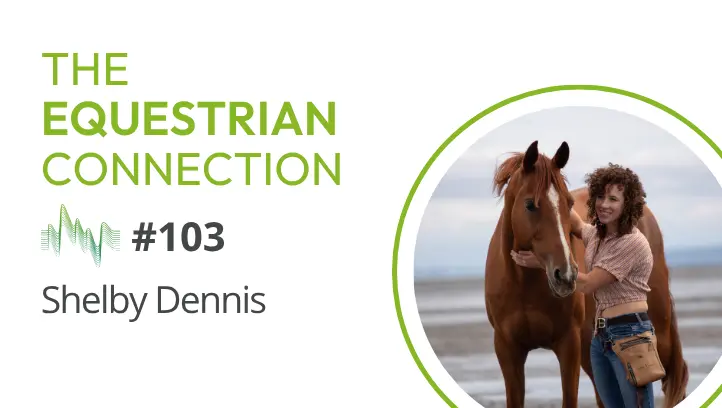
#103 Understanding the Secrets of the Horse with Shelby Dennis
Shelby Dennis is a professional horse trainer, behavior consultant, and author.
From the Arabian horse circuit to hunter/jumper to dressage and exercising race horses, Shelby’s practical experience with different kinds of horses has made her a well rounded horse person. On top of her practical experience, Shelby has also taken several Equine Science based courses through Guelph to work towards her Certificate of Equine Science, choosing to emphasize her studies and education on Equine Behaviour. In early 2021, Shelby received her Equine Behaviour Consultant certification from the International Association of Animal Behaviour Consultants.
The understanding and correct application of equine learning theory has allowed Shelby to hone her skills as a horse person and continue modernizing her approach as a trainer, with emphasis on equine ethology and ethical practice. Shelby attributes her history with horses to shaping the hardworking, patient and driven individual she is today.
Connect with Shelby:
Website: https://milestoneequestrian.ca/
Podcast Transcript
This transcript was created by an AI and has not been proofread.
[SPEAKER 1]
[00:00:01-00:00:06]
In this episode, we're talking with Shelby Dennis, a professional horse trainer and behavioral consultant.
[SPEAKER 2]
[00:00:07-00:00:32]
Because there's often multiple truths when we're looking at what's going on with horses and understanding my own motivations and my behaviors. And like when I'm overstimulated or when I'm stressed, then I'm more likely to snap or be less focused or struggle in other ways. With horses, it's very much the same. When they're trigger stacked and they're struggling with other things or they're in an inadequate environment, that's going to come out in their behavior.
[SPEAKER 1]
[00:00:32-00:02:04]
Welcome to the Equestrian Connection podcast from WeHorse. My name is Danielle Kroll and I'm your host. From the Arabian horse circuit to hunter jumper to dressage and exercising racehorses, Shelby Dennis's practical experience with different kinds of horses has made her a well-rounded horse person. And on top of her practical experience, Shelby has also taken several equine science-based courses through University of Guelph to work towards her Certificate of Equine Science, choosing to emphasize her studies and education on equine behavior. In early 2021, Shelby received her Equine Behavior Consultant Certification from the International Association of Animal Behavior Consultants. And the understanding and correct application of equine learning theory has allowed Shelby to hone her skills as a horse person and continue modernizing her approach as a trainer with emphasis on equine ethology and ethical practice. Shelby attributes her history. history with horses to shaping the hardworking patient and driven individual she is today. Also, fun fact, this is Shelby's second interview with us as I originally interchatted with her back in the spring of 2023. So I'm excited to see what she's up to now. So let's dive in. Shelby, welcome back to the WeHorse podcast. It has been like crazy to think it's been about three years since the last time that you were on episode 26. We're now in episode, I think like 102 or 103. So yeah, it's been a little while. Welcome back.
[SPEAKER 2]
[00:02:04-00:02:08]
Yeah, thanks for having me. Time flies. I can't believe that much time has passed.
[SPEAKER 1]
[00:02:08-00:02:22]
I know. It absolutely does. So for anybody who is new to your work or who haven't listened to your previous interview with us, can you tell a little bit about your journey into horses? What led you to where you are today?
[SPEAKER 2]
[00:02:23-00:06:36]
So I started riding when I was four years old and I started out riding Arabian horses on the Arabian show horse circuit. And my initial intro to horses was really punitive training, really harsh, forceful training. And I was taught things like you need to get after them. You can't let them get away with it. And initially my response was that I didn't want to be mean to the horses. I didn't want to hit them. I didn't want to kick them or risk hurting them. But I was told things like, oh, if you don't get after them, they're going to get away with it. Then they'll try it with someone else and it'll be your fault if they hurt someone else. So over time, that kind of shaped my perspective of how I needed to show up for horses and how. I needed to train them. And it shaped my entire reality, especially being a child in a very insular breed show community where I was seeing a lot of the same things exemplified by everyone. I truly didn't know that there was alternatives. And then as the internet started to take shape and I had more access to different people online, I started joining social media websites when I was like a young teenager in high school. And I was exposed to new information that. Started to lead me to question things. And then on top of that, when my family experienced financial hardship and we went bankrupt, my Arabian show horse got moved from a show barn to a backyard style barn. And I don't use that in a degrading way. It was just, it wasn't a competition focused barn, but he went from being in a stall paddock situation where he was stable for most of the day to being out on 20 acres with the herd. And basically overnight, my Arabian who spooked at everything was bolting and very difficult to handle at times. He went from that to basically being bomb proof. And that was one of the first really big shifts that I had because I hadn't changed any of my training at the time. I hadn't done anything other than provide him with more species appropriate care. And I didn't even do it deliberately thinking that it would be that much better for him. I did it because it was a cheaper barn to be at. And that was one of the most eye-opening moments for shifting how I do things management wise. And it showed to me that a lot of the things that I'd been told about why he was behaving the way he was, I was told it was because he's in a race. And that's just the way that they are. But a lot of it actually stemmed from how he was kept. And then from there, I started to get more involved in riding different types of horses. I started to work with off the track thoroughbreds. And then eventually I adopted my horse Milo from the SPCA. And he was kind of the next big shift in mindset because I very quickly realized that the really forceful methods that I'd been taught to use growing up would not work on him. Because when I tried to get after him and force him to do things that he didn't want to do, he would literally square up with me. And it really exposed a lot of holes in my understanding of horse behavior and training. And. He was the next big push to start studying horses from a scientific perspective, learning more about their behavior and why he was responding the way that he was. And it was a slower shift from there because I was kind of trying new things and trying to learn how to apply different types of training methods. And I was also a little bit in denial of the fact that so much of what I had learned wasn't necessarily the best way or wasn't even accurate in the first place. And that was really hard to come to terms with. But he was a huge catalyst for shifting my perspective and causing me to gain the education that I now have and taking me to where I am today. So now I have my certificate of equine sciences from the University of Guelph. I'm certified through IAABC as an equine behavior consultant. And I've also done a little bit of like human psychology study in post-secondary, which also really helped. me start to get a grasp of how mammals think and learn and feel because there's so much crossover with mammalian nervous systems and similarities. And it's really changed how I view the horse world today, how I want to show up in the horse world today, because so many years growing up, I thought I wanted to be a competitive show rider and go to the Olympics and stuff. And now my priorities have very much shifted. And I am much more about promoting better welfare practices for horses, teaching people about horse behavior, and helping to correct some of the belief systems that we see in the horse world today.
[SPEAKER 1]
[00:06:36-00:09:18]
Mm. So cool. I also love that story that you, you have with your, you know, that original Arabian. When I was 19, I, um, I bought a little quarter horse cross and I remember when I went to go try her out, um, she was in a straight stall that the barn was like pitch black. Like there was like no light in that barn at all. And I remember looking around and thinking like, there's not really any turnout here, you know, or like if it is, it's like teeny, teeny, tiny little, you know, little paddocks. I would even call them more of a corral, honestly, than a paddock. And it was with a ton of other farm animals. So I was thinking like, what is like, what is her living situation here? Anyways, I bought her. She, you know, I remember I got on her and I thought, my gosh, like this is just such a gentle horse. And then I brought her to a barn. where they were kept in box stalls. And she just flipped a switch. If you even approached her stall, not entered, but approached it, like she lunged over the door at you, like was just really, really aggressive. And the owners actually said, like, you need to like take this horse and go. Like we're not keeping her here. It's she's not safe. So I brought her to a firm that was like a huge acreage. They had like 25 horses that all lived out in a herd together. And I remember I thought, I'm never going to see this horse again. And I turned her out and she became the, like looking back when I thought, oh, what a gentle horse. She was actually just very shut down, you know, and she would like come, like come running when you called her. She ended up like my, the instructor that was there, she had a lesson program and she was like, could I use her in some of the lessons? Like she's just such a good horse. And it was, you know, a really, really big eye opener for me at that time to look at. Original living conditions of like this shut down straight stall dark barn situation to moving into a box stall and still not being ideal but her thinking I have enough room to move around and tell these humans to f off basically and then to be turned out in this huge herd situation and finally feel like a horse again you know you really start to to see her true personality and her real like behavior, which was like a happy go lucky little horse. And it was just, it was, it was an experience that I wish she didn't have, but I'm glad I was able to witness because it taught me so much.
[SPEAKER 2]
[00:09:18-00:09:46]
I think it's so eye-opening and like what you said, like seeing her true personality, I think that's so key because a lot of people will label horses as being difficult or bad or cranky. And being unhappy, like it's not a personality, it's a response to the environment. And there's so many horses that I feel fall through the cracks because of things like that. And people don't give them the chance to see if they'll do better. And the environment plays such a huge role in their behavior.
[SPEAKER 1]
[00:09:46-00:10:20]
Yeah, absolutely. I'd love to know too. So you have a really diverse background. So you said, you know, you started off with Arabians. I believe you did things with thoroughbreds as well. Correct me if I'm wrong. Yeah. And so you have like a hunter jumper background. You have a racehorse background because it wasn't just now I'm going to. Again, correct me if I'm wrong. I'm going to relay some of the information that I think I have here. So you worked with racehorses, like helping to exercise them. And then you also did like off the track thoroughbred retraining program. Is that correct?
[SPEAKER 2]
[00:10:20-00:10:40]
Yeah. So I galloped racehorses on the track as an exercise rider. And then through that, like also before that, I was already working with off the track thoroughbreds, which is kind of what got me. me interested in wanting to work at the racetrack. But as I started to gallop them, I got even more access to getting them off the track and retraining them and rehoming them and doing things like that.
[SPEAKER 1]
[00:10:40-00:11:06]
Yeah. Okay. So like the different breeds, the different disciplines, I mean, we have dressage in there, we have obviously the behavioral, you know, sciences and stuff in there as well. So with all of that diversity, like, has that kind of shifted how you see things? Or are you looking at things and being like, there's really not any difference. We just seem to like compartmentalize these horses as different things because we are lumping them in different disciplines and different breeds.
[SPEAKER 2]
[00:11:07-00:14:16]
Yes and no. Like I'd say that my experience with racehorses on the track, it gave me a lot better of an understanding of off the track thoroughbreds and why they behave the way that they do. And I also got a front row seat to seeing like vet checks and seeing what came up on the vet checks and getting a really good grasp of what problems horses typically had and like at what ages. And that was very eyeopening. So I found that that was really interesting. And I also worked for a really good trainer at the track for most of my time there where she was a lot more progressive and considerate of the horses, which I'm really grateful for. So it's kind of shaped my perspective a little bit differently in that a lot of people I find in the horse world, they'll have a much easier time pointing fingers at the racing industry as being very problematic and abusive. And my experience with all of these disciplines is that all of the ethical problems we see in one discipline or present elsewhere. It's just in varying severities in different degrees. Like I don't view the racing industry as any ethically worse than most other competitive disciplines. It's worse in certain aspects and it's also very visible. So people can't hide what they're doing as much. Whereas in the show world, it's very hush hush. And you can hear about people doing horrible things to horses and even being caught publicly doing them, but people kind of sweep it under the rug and it doesn't get talked about as much because it's a lot harder for the general public to bear witness to that. So. Generally speaking, I'd say that there's a lot of consistency across the board for all horse sports with the ethical issues that we see with the belief systems that people hold. And in my experience of working with different breed types like the Arabians and Thoroughbreds, because those are two of some of the most misunderstood breeds, my experience with those breeds is I don't think that they're more spooky or difficult or insane than other breeds. I think that they're very sensitive. I think that generally speaking, they're very highly intelligent and in tune with their environment. So I think that they're less resilient to coping with certain stressors without having it be outwardly visible in their behavior. But I think that largely what we attribute to breed specific traits with horses like that stem from the care practices that most of them are under. Because with Arabian show horses, a lot of them are stabled far too much. Race horses pretty much across the board in North America are stabled 20. 24-7 at the racetrack. And a lot of the problem behaviors that people are then calling breed traits are actually stemming from the shared trauma of the environment that these horses are growing up in, rather than being specific to the breed. So that's something that I've also noticed too, where it's like these misunderstood breeds that a lot of people don't like because they're difficult. I think that a lot of the dislike actually stems from the fact that people can't get away with putting them in subpar conditions and mistreating them to the same extent that they can with other breeds like quarter horses for example tend to be very adaptable horses in the sense that they can put up with a lot of stuff without completely losing the plot, which is why trainers can get away with like doing things like hard tying them and not have as many accidents as you might see with the hotter blooded horses.
[SPEAKER 1]
[00:14:17-00:14:48]
All right. I have two questions stemming from that. The first one is, If anybody follows you on social media, they probably know that you're quite outspoken about horse welfare. And I would love to know, do you feel that the industry is changing for the better? Because we are seeing, you know, more awareness of things. We're seeing, you know, people being a little bit more educated on certain practices. So do you think it's changing for the better or do you still think there's, you know, some major blind spots?
[SPEAKER 2]
[00:14:49-00:15:39]
I think that the people in it are like, especially the younger generations are changing for the better. But I do think that the competition industry as a whole is kind of digging their heels in and not wanting to. see that change and trying to discourage people from believing that change is possible or that it's beneficial. So I think that like two, there's kind of two truths there where there's a lot of resistance, especially with diehard traditionalists, like people who've been in the industry for years and don't want to reflect on practices, but then there's a lot of people who are starting to shift. So I think what we're going to see is that there's going to be more people who are wanting to engage in welfare first practices. But at the same time, we're going to see an increase in people resisting that and getting louder in their resistance because the more people that start to shift practices, the more threatened those who don't want to change become.
[SPEAKER 1]
[00:15:41-00:16:14]
The horse industry is very much a reflection of the state of the world. Yes, it is. All right. My second question from that is you had said about, you know, there's some very highly intelligent horses that people just don't seem to understand. And so they kind of lump them as a category. And so you have also spoken openly about neurodivergence and, you know, how that intersects with interspecies communication. I would love to know how you're under, how like understanding yourself has changed the way that you understand horses.
[SPEAKER 2]
[00:16:15-00:18:47]
So I grew up not knowing that I was neurodivergent because I got diagnosed in my 20s. And so a lot of my life was spent feeling ashamed of what I couldn't do or what I struggled with compared to other people. Meanwhile, there were also a lot of strengths that I had that other people couldn't do, but I was made to feel inadequate for not being able to fit into a box and be obedient in the way that neurotypical people might be in classes and like getting distracted less and whatnot. But as I came to learn more about myself, I realized that a lot of my struggles are specific to having ADHD and they do make certain things more challenging, but there's also a lot of great strengths that I have where I have found that in comparison to people who are neurotypical, I'm more capable of abstract thinking and thinking with nuance than many people are, which is a blessing and a curse because I do find it very frustrating to talk to people who can only perceive things in a black and white perspective. But it has allowed me to kind of look at all of the shades of the picture when it comes to horses, because there's often multiple truths when we're looking at what's going on with horses and understanding my own motivations and my behaviors. And like when I'm overstimulated or when I'm stressed that I'm more likely to snap or be less focused or struggle in other ways with horses, it's very much the same when they're trigger stacked and they're struggling with other things, or they're in an inadequate environment, that's going to come out in their behavior and learning more about myself and the pressures that I was put under for school and whatnot, it's given me more compassion for the horses because ultimately a lot of people's expectations for horses are super unfair where we want them to be perpetually obedient. obedient and never offer us any resistance or problems, even when we're not meeting their needs at all. And that's not a fair expectation to have of anyone. Like if you had a friend who is perpetually stressed and they're not having any help with that stress and they don't have an adequate environment to live in, their needs aren't being met, it would be completely unreasonable to expect that friend to be their best self and to be able to show up in life the way that they could if those needs were met. And the same applies to horses. And unfortunately, a lot of times we're holding horses to a higher standard of behavior than what we hold ourselves and other humans to, which really is unfair because ultimately we are the ones that have the most say over their lives, over what they're doing and the capacity to educate ourselves and learn more and develop. Develop more context.
[SPEAKER 1]
[00:18:49-00:19:29]
I love that, you know, that perspective, like that awareness that you're able to give to our audience and myself included, you know, like you had said, to lower our expectations a little bit of these animals that, you know, are are doing their best on a day-to-day given the environment that we provide for them, you know, and to have more compassion and to have more empathy for humans and horses and, you know, all mammals really. So yeah, I just, I love that awareness. When we look at your latest book, the second book that you've now written, Secrets of the Horse, do you speak to that within the book?
[SPEAKER 2]
[00:19:30-00:20:56]
Yes, yeah, I talk about neurodivergence and some of my experiences growing up and how I was pressured by teachers or treated a certain way and how I feel that mirrors a lot of the expectations that we have of horses, where essentially we are expecting them to fit into the world that we've constructed and built for our convenience and do so without making mistakes or disrupting our schedules and our needs. And it's not a very fair sentiment to hold. So I found that there's a lot. Of parallels that you can draw between the conformity that is expected of neurodivergent people in a society that typically favors how neurotypical people think, feel, and engage with their environment, and what we do to horses. So there's a mirror that can be drawn there for sure. And I also do feel that for neurodivergent people, having access to horses and being able to interact with them and animals in general is really healing because they don't judge you and they're a lot more honest with their behavior and they there's no you don't have to read between the lines there's no code there's no social graces that shift and change depending on where you are it's a lot more cut and dry so for me being able to watch animals and learn about their behavior is something that I enjoy a lot more because it's it's much lower stress than interacting with people even though horses can still be dangerous but they're typically a lot more clear with their behavior than people are.
[SPEAKER 3]
[00:20:56-00:20:59]
Yeah, absolutely. Since
[SPEAKER 1]
[00:21:00-00:21:06]
It is. We're now on the topic of like clarity. The title is called Secrets of the Horse. Can you tell us what that title means?
[SPEAKER 2]
[00:21:07-00:23:15]
So most of the things in there aren't actually secrets, but they're things that are like overlooked and not paid attention to. So in essence, to a lot of people, they are secrets because they're not things that are widely taught. In our industry, I think one of the most shocking things is that there are so many practicing professionals and trainers who have no real concept of learning theory or operant conditioning, and they can't explain how they are affecting behavioral change in the horse from a scientific perspective. And everything is a science. So this isn't even to say to people like, oh, you have to become a scientist, but understanding the cause and effect of what you are doing to create behavioral changes in your horse and understanding what is likely driving their behaviors should be a prerequisite before offering any type of professional services or speaking as an expert. But in our industry, it's very uncommon. There's this massive lack of understanding of the science behind training and having empirical evidence and information to back claims. A lot of it stems from tradition, belief systems, status, and elitism that is oftentimes founded in competition prowess and like how well, like how much someone has won in competition. And that is used as their symbol of knowing. And it's very problematic because ultimately, the lens we need to be looking at horses through is that obedience is pretty irrelevant if it is obtained with excess force and comes at the expense of the welfare of the horse. So yes, horses can do a lot of amazing athletic feats. They're incredibly athletic and talented animals, and they're very smart and they're very trainable. But ultimately, none of those skill sets matter if they come at the expense of the welfare of the horse. And that's kind of the lens we need to start viewing training through. And that's the secret is looking at what your horse's behavior says and what they're likely experiencing and starting to train in a way that prioritizes the well-being of the horse instead of just fixating on getting results that are for the human, but often come at the expense of the well-being of the horse.
[SPEAKER 1]
[00:23:18-00:23:48]
I've, yeah, I fully, fully, fully agree with all of that. And I especially want to highlight what you had said about the placing of authority on somebody based on, you know, what they've won specifically when it's like, That can really have very, very, very, like somebody's resume from a competition perspective can have very little weight when it comes to their actual knowledge on welfare and behavior of an animal.
[SPEAKER 2]
[00:23:49-00:25:14]
Yes, especially when you factor in how much privilege is often involved to have access to shows in the first place, because there's a lot of incredible horse people that will never get to be seen on a public. level like that because they simply can't afford to. And that doesn't cancel out their talent. So that's also something that I've really shifted away from because it was a hard spot for me growing up because I was so competition minded initially. And then my family lost all of our money and I no longer had access to that in the same way that I did. And watching how people in my life started to devalue me when that happened, when nothing had changed other than the fact that my family couldn't afford to spend as much money at the barn. It was very eye-opening to me because it made it pretty clear that it's not really just about talent and desire to do well. It's also about who can pay to be part of that club. And while some people who don't come from money still manage to make it to the top, they are the exception to the rule if you look at the privilege of most of the people who are at the top. So the other issue there is that there is a lack of variety in the types of people that are being given voices of authority. And there's a whole lot of privilege and elitism involved that ultimately erases the voices of people who are self-made and who have. Experienced and done amazing things with horses, but don't have the capacity or desire to show it on a public scale in the limelight at competitions.
[SPEAKER 1]
[00:25:15-00:26:49]
Such a good point. I remember when I was growing up, um, Same thing, didn't come from a ton of money. By no means, you know, in a poverty level, but, you know, very like middle class. And my parents, they said, if we're going to buy you a horse at that time, you know, everybody was fitting on a pony and they said, we're not going to, you know, get you something that we're going to have to resell and buy something else and everything like that. Like, we don't want you to grow out of anything. So we're just going to get you a horse. And what they could afford was an off the track throw bread, me at 12 years old. And so it was a very big learning experience for me. But I had a really hard time fitting in because I was treated very differently, you know, on this horse that both of us were trying to learn, you know, together, basically. Meanwhile, everybody else was, you know, doing their pony hunters and everything like that. And I ended up actually leaving horses when I was younger because I just, like you said, it had such a privilege and elitism vibe to it that I just didn't fit in. Which is really sad for, you know, not only children, but also adults who are doing this because they love it and they love the animal. And they, you know, have a hard time, whether it's emotionally or financially or a combination of the two.
[SPEAKER 2]
[00:26:51-00:27:37]
Absolutely. Yeah, it's really hard to if you don't come from money, a lot of people are having to train up their own horses and even just like sitting in that process. where you're slowly having to bring up a green horse. A lot of people don't respect that as talent when you're jumping like little cross rails and whatnot, but it's a different type of talent because people who are competing at the top, a lot of them don't start their own horses. They get already made horses that they're then riding, but there's a lack of appreciation, respect for the people that made those horses to that point for those professionals to get. And the people who are at the top in the limelight often get all of the credit. Meanwhile, there's people in the background that ultimately without them, they wouldn't be able to do what they're doing because they aren't the ones actively training the horses to that point.
[SPEAKER 1]
[00:27:38-00:27:54]
Absolutely. Apart from what we've already discussed, including neurodivergence, are there any other like big conversations within the horse world that you're hoping that the book Secrets of the Horse will either like challenge or expand upon?
[SPEAKER 2]
[00:27:55-00:31:54]
There's a few like the one big one is about management and how it influences behavior. So it's very common for horses to be kept alone and in small areas. And as a social herd animal, it's really sad that we're in 2026 and that that is still widely debated because from a scientific perspective, it's not up for debate. It is what it is. And I often say these things very bluntly and it offends people. But when you're just talking about empirical evidence and science, you don't bring emotions into the picture. The truth is the truth, regardless of how people feel about it. Horses are social herd animals. The way that a lot of them are kept is damaging. creates a lot of behavioral issues that are then covered up with harsher equipment, harsher training, and harsher attitudes towards the horse. So management is a huge one that if we were to address the management issue in the horse world, a lot of the quote unquote need for harsh equipment would go away because the behaviors that people are needing to try to control through that harsh equipment would cease to exist if the horse's needs were more adequately met. And then the other aspect that I touch on in the book that I think is a really important one is looking at the historical use of horses. Until relatively recently, they were pretty much exclusively used as work animals to work farms, as transport, as vehicles during war. The training of them has largely been shaped from that original use and it has not seen much change. And nowadays, the average use of horses is for pleasure and pleasure riding and competition riding for fun by humans. It's no longer a necessity, but we're still approaching training in the same way where there's not. The room being left to consider the horse's perspective, the horse's emotions, the horse's physical and mental well-being, where the priority is still getting the means to the end in training and achieving certain results, when there's no longer this need to do that. Like you're not going to not be able to feed your family because you can't ride your horse. You're not going to miss going to work because you can't ride your horse. So there's no longer these dire needs for horses to be used in the way that they are. And we have the capacity to be more considerate of their well-being now because they are no longer a necessity for building the world we live on. Yet a lot of the training and handling practices that we've learned about horses still stem from back in that time. And there has not been that much change and adaptation, like even looking at things like horseshoes. If you look at the traditional design of the metal horseshoe, we're seeing more changes now in recent years, but it is still widely used to just use this traditional steel horseshoe with no frog support. Despite all the research we have showing that horses need frog support for the horse to function properly and for their hooves to be healthy and seeing all the rampant dysfunction that we see in horse hooves across the industry, there's still been that very little shift. And we're not, we're also not riding horses on. Concrete and hard ground most of the time anymore, or for the same level of distance that they were being used for back in the day when horseshoes first came about. So there's a lot of things that I do think are steeped in tradition that are very resistant to change, even in the presence of a wealth of information that supports the need for change. People are still openly rejecting information. And a lot of these studies that we have, they've been replicated for decades and decades. So it's not even like this information is new. It's just that we're that slow to start to apply it. In the horse industry, which is one of the biggest problems that we face as well, is the lack of acceptance of empirical evidence, because it's not coming from the people who are preaching the gospel. at the top of the sport and the people who are given the most authority in the sport, even though they aren't the authority voice on horse welfare and behavior and physiology and biology, because that's not their area of expertise. It's the riding. And we're not talking about how to do a Grand Prix dressage test or jump a meter 60 course. We're talking about the ethics behind how the training to get there was achieved.
[SPEAKER 1]
[00:31:54-00:33:20]
Mm. That is all like, I just want to highlight and underline everything, the asterisks, everything that you just said. Absolutely. I mean, the idea that we're not riding horses into war, we are not, you know, they are no longer the main way for us to harvest our fields and, you know, put food on the table. They're no longer building our roads or our highways, you know, anything like that. And so the fact that we are still training them as if we need them to be, you know, that quote, obedient to be able for us to, you know, move society forward. Is absolutely ridiculous. And it is such a good point. So I'm so glad you brought that up. So, so, so glad. I just recently, a few weeks ago, interviewed Dr. Steve Peters here on the podcast, who is a neuroscientist and studies the horse's brain. And so it was a really interesting episode about like, horse brain versus human brain. And I would love to know from the behavioral perspective as well, is that if we know that horses don't communicate the way that humans do, what are some ways we may be unintentionally making training harder because we are still looking at things through a human lens?
[SPEAKER 2]
[00:33:21-00:37:30]
I think one of the biggest ways people do that is with like the desensitization process of getting horses used to new things. There's this attitude where we're like, oh, I know this isn't scary. I know this isn't dangerous. Therefore, my horse is overreacting and they should be calm at the pace that I introduce it at, even when they're showing me they're not. And a lot of times people are introducing things way too fast. And if they just slowed down a little bit, they would get better results because they wouldn't ignite that high stress response by going too quickly. And there's also this attitude too, if the horse spooks at the same thing multiple times, they'll be like, oh, they know what that is. They're just being silly. But it fails to recognize the fact that like as flight animals, horses have survived and adapted to be suspicious of anything that a predator could be hiding behind. So yeah, that rock on the ground over there, nine times out of 10, it might be a rock, but the 10th time there could be something hiding behind it that's going to attack a horse. And that's how they have been wired to survive. So they need to be suspicious of change. And the other thing that I think people get caught up in, and this is where human ego becomes a massive problem, is this idea that our... sensory experience is the same as the horse. Horses have way better hearing, they can see better at distance than we can, and their sense of smell is phenomenally better than ours. So they are taking in a lot of sensory input that we completely overlook because we just don't have the capacity to notice these things. And we've also grown up in a world that largely serves us and where there's not as many potential threats to harm us. So we don't have to be as hypervigilant. And that colors the way that we handle and train horses because we're looking at things through a humanistic lens rather than looking at the experience of the horse. Because bottom line, even if your horse is spooking at something that you think is really silly, that doesn't change the reality of their fear. Like they're not faking being afraid. Their fear experience is real. And if you think that they're spooking at something silly, it is your job as their trainer and handler to show them that they can feel safe because the fear response comes from a lack of feeling safe. And one thing that will never make horses feel more safe is getting mad at them for that response, escalating the amount of fear that you're introducing into their life, or just making it even harder to cope. You have to help them learn how to regulate in those moments and come down from that stress response and feel safe. And that's ultimately what builds resilience. But unfortunately, a lot of horse training is more about maintaining that stressful stimulus until the horse seizes the outward reaction without addressing the internal state. So yes, they're now frozen and they're no longer longer reacting, but they don't feel calm. So you've never actually improved their capacity to regulate. You've just taught them that they can't affect change in their environment and that they just have to shut down and cope because the issue is not going to go away. And then that doesn't promote safety. And essentially it builds these horses that are largely ticking time bombs because they've learned that they have no autonomy and no agency in their life and that things just happen to them in training and that they just have to shut down and cope with it. And that... Creates a chronically stressed horse and eventually a lot of these horses will find something that is fear-provoking enough that it overrides that shutdown response and then you get these big explosive reactions or especially things like where if the rider eventually falls off or loses control of the horse the horse bolts and goes as far away from the person as they can because that person's not their safe place and so if you're tying your personal presence to the horse feeling overwhelmed and having no choice and never actually getting to achieve safety around you. You're not going to be someone that they look for when they're afraid. But if you train in a way where it's about creating safety and relaxation, even if your horse spooks and does get away, they might run a little bit of a distance away, but they generally come right back to you because they feel safer around you and they want to seek safety. And that's what happens in a herd setting. So while they know that we aren't horses, if we are a beacon of safety for them, it helps us in training because they'll seek us out when they feel unsafe and they seek us out for support. But if we are their primary cause of stress,
[SPEAKER 1]
[00:37:30-00:41:25]
then that's not going to happen. Absolutely. Are you feeling inspired to put as much focus on your end of the partnership as your horses? Here at WeHorse.com, we have over 150 courses with top trainers from around the world, covering everything from dressage to starting young horses to jumping and cavaletti training to groundwork and horsemanship. And we also have courses designed to help you become more grounded and present with and without your horse. This includes courses like the Mindful Equestrian and Mat Work for Equestrians with yoga teacher Kathy Woods. Check out WeHorse.com for a free seven-day trial to get started. And as a member, you get access to everything in our WeHorse library to watch whenever you want. And we also have an app, which means you can download a course or video to watch without Wi-Fi, which is perfect for those days at the bar when you just want a quick dose of training inspiration before your ride, or in this case, to ground in and feel a little bit more mindful and present before you meet your horse. So what are you waiting for? Go to WeHorse.com and check out our free seven-day trial to access our WeHorse library, see if it's a good fit for you, and start training with our amazing trainers today. We can't wait to see you in there. And now back to the episode. Also to acknowledging that, you know, Like two different horses can have two very, very different responses and reactions. And so we need to. not like kind of be aware of that when we're training, because if we're working with one horse and maybe this is sort of the response. And so this is the way that we then respond. And then we switch it and we work with the same way with a different horse. I'm thinking of my two horses. So here on my property, I have three. I have my two horses, a mare and a gelding, and then I have a foster pony. And my mare and my gelding are polar opposites in terms of their confident levels and, you know, the way that I work with them. My mare is very confident. She is super sure of herself. She is, you know, the little herd leader. And my gelding is he, he is not. He's an unconfident little guy. And I remember one day I was in my ring and I'm in the woods. So I'm completely surrounded by trees. And, you know, we're always in, you know, if we go in the ring, it's the same thing. We have the one location. We're not traveling around. It's, you know, nothing's changed. And he was really, really spooky. And I kept thinking, like, there's really no reason that he is like this, but I'm going to believe what he says. And so I'm going to completely switch gears from what we were going to be doing. And we're going to do something completely different. You know, a lot more just like chill and... Sort of more relationship focused groundwork rather than what I was going to do of like lunging and getting his stimulus up and all of that stuff. And I come to find out later that my father-in-law who lives next door, we have a trail system that kind of runs, there's wood separating between the ring and the trail system, but there's probably like 50 feet of woods. And he was walking his German Shepherds along the trail system. And I had no idea. My human senses did not pick up on that, but his horse senses did. And I feel like if I had have been like, get over it, there's nothing here. You're in this ring all the time. You know, it wouldn't have gone well, especially for his sensitive little self. And so when I believed him and therefore changed our plan, it was almost like, I don't know, we were able to deescalate the situation a little bit.
[SPEAKER 2]
[00:41:26-00:42:00]
Absolutely. I think that's the thing is listening to them and giving them the benefit of the doubt. It builds resilience over time and then you don't run into those issues as often. But I think a lot of people get caught up in the moment with their plan and they'll be like, oh, I wanted to jump today or I wanted to do X, Y, Z today. And then they get so set on that that they just want to force it. But in the long run, it ends up slowing things down and creating more problems because the emotional state of the horse isn't being prioritized. And ultimately, like all of the behavioral issues we see are driven by an inner state that the horse is feeling. So we need to be mindful of it. that in training.
[SPEAKER 1]
[00:42:01-00:42:10]
Yeah, absolutely. It's like that, that quote that says, um, you're not training the horse you had yesterday. You're not training the horse you'll have tomorrow. You're training the horse you have today.
[SPEAKER 2]
[00:42:11-00:42:11]
Yes.
[SPEAKER 1]
[00:42:12-00:42:12]
Yeah.
[SPEAKER 2]
[00:42:12-00:42:13]
Yeah, exactly.
[SPEAKER 1]
[00:42:14-00:42:48]
So. dominance-based thinking, which is kind of that same line that we have here. Again, your work often challenges that. When I say dominance-based thinking, and again, you can elaborate on this, of course, but it's kind of like what we had just said that, you know, get over it because I said so, adding gear, you know, all of those different things. Is there a reason why you think it's so deeply rooted in the horse world, even above and beyond like this idea of like traditionalism or, you know, following these, you know, quote, leaders and the way that they've always done it?
[SPEAKER 2]
[00:42:49-00:47:07]
I do think that there's massive ties to a patriarchal mindset and how people approach horse training and that a lot of it is about feeling powerful and inflicting power over another being and viewing that as a win. And I think the biggest issue with dominance-based training is that it prioritizes obedience above all else. And that's really the standard that people are looking to set. And it also carries this sense of entitlement where you feel entitled to the horse responding to you in a certain way, whether you've earned that or not. And ourselves and all animals, like we're all individual beings who will feel different on any day of the week. And like, whether we're feeling well or poorly mentally or physically, like our experience still matters. And a lot of dominance-based thinking surrounds this idea that any misbehavior on the part of the horse is a slight against you and an attempt to disrupt some made-up hierarchical system. And that's not what horses are thinking. Like they, if you watch horses in a natural setting with how they interact in herds, especially when they're more far removed from people, like they very much want to seek harmony. Like wild horse herds, yes, you can absolutely capture stallions fighting. But if you actually watch those fights, oftentimes they're fairly short lived. There's lots of breaks. There's lots of running away. And they don't fight as anywhere near as often as what people might think. They're just a more documented thing when people are recording those behaviors because it's interesting to watch and it's exciting. But horses try to seek harmony. They don't want to have conflict. They don't want there to be problems. And a lot of conflict stems from unmet needs or being stressed or being put in situations where they're uncomfortable. And the dominance-based thinking, as far as I'm concerned, it's this human sense of entitlement to having power over another being, no matter what. And from that sense of entitlement, it creates this dynamic where it's you versus the horse, rather than you and the horse versus the problem. Because ultimately, we love to talk in the horse industry about how it's this beautiful partnership and how the horse is first all the time. But if you actually break down the common themes in people's thinking and the justifications in training, it's oftentimes not actually true in practice because a partnership implies there's mutual value in communication on either side. But in a lot of horse training, if the horse is ever communicating something that the person doesn't want to hear, it's viewed as a problem. And it's like, oh, no, you communicate just not like that. So the only communication that's really accepted is communication that falls in line of the obedience that people feel entitled to. And ultimately... Obedience has no basis in welfare. Like there's definitely things horses need to learn for safety purposes and whatnot, but obedience isn't an indicator of like a happy, well-adjusted horse. You can have a highly obedient horse that's extremely shut down and unhappy. And a lot of the dominance-based mindsets create that as an inevitability because ultimately, if you feel entitled to obedience all of the time, you're going to have to walk over your horse's communication and ignore what they're trying to say and view their behavior through the lens of being a problem. And the other issue with that is I think it creates horses who have very little self-preservation and who initially will attempt to communicate like, hey, actually, I'm in pain right now. But then that's very quickly overridden. So then they're placed in situations where they're working through discomfort and end up causing long-term injuries that aren't discovered until they're far much far worse because people aren't listening to the earlier signs because they're viewing any unwanted behavior as disobedience or something to disrupt the dominance hierarchy. And that's, it's just not how horses think. It's not founded in any sort of scientific fact. It's a very humanistic perspective. If you look at how we operate in society, there's a very hierarchical structure that's about obedience and status and obeying people simply because they said so. And like, oh, viewing respect as obedience when really they're not the same thing. You can deeply respect someone and still disobey them because ultimately people are not entitled to your obedience. And that doesn't mean that you don't respect someone just because you're not going to listen to them 100% of the time.
[SPEAKER 1]
[00:47:10-00:48:37]
I find it so funny, this idea that horses are seen as like this symbolism of like beauty and freedom and like people like, I mean, whether they're in the horse world or whether they're not in the horse world, they, you know, when they think of a horse, they might think of like this, like horse, like galloping through like a field. When in reality, so much of the horse world is actually, you know, like bits and spurs and tight reins and enclosed fences and, you know, and everything like that. And it's kind of the exact opposite of this idea that people have of horses. It's like, be beautiful and free and, you know, so graceful, but like not too much. And it, to me, it's when you said like the, the very patriarchal, patriarchal comparison, it's so similar to the same way that, you know, the patriarchy. is with women as well. Be beautiful and, you know, all of the things, but not too much. And so I just, I find that really, really interesting how, again, it's like this idea that It's our human expectation that we place on them for what we want to, quote, do with them. And, yeah, the way that we want them to be. So I just, I find it fascinating and heartbreaking. And what you said was so profound. Neuro look on it.
[SPEAKER 2]
[00:48:38-00:49:01]
Yeah, I definitely think that, unfortunately, it's something that we're going to need to unpack in the industry is how much of the value of a horse and like whether or not they're going to be treated with kindness is rooted in how well they obey and how easy they are to use for human purposes. Because ultimately, if we love horses for who they are, that love should maintain whether we're capable of using them for our desires or not.
[SPEAKER 1]
[00:49:02-00:50:31]
Absolutely. I say this all the time with my mare, Soda. When she was about five or six, she had a pelvic injury, which actually it was before because we discovered there was scar tissue. So we don't really know when it happened. I got her when she was four. And it's, she slowly started to have more and more issues with it. And so she had, when I, you know, when I got her, she was, Like this horse that the horse industry would say has so much potential, you know, had a really bright future ahead of her. And then all of that was starting to be taken away. And the amount of people that said, get rid of her while you still can. It was disgusting to me. She lives the most beautiful little happy life here, you know, on my property, doing whatever she wants to do at this point. And it was a really, really big wake up call on the perspective of worth, not only from. The expectation that we put on horses based on what we paid for them. Well, I paid this much for you, so you have to live up to this. Or they're breeding. You know, all of those different things. It's really, really wild to think of. the cost of worth versus inherent, um, inherent worth.
[SPEAKER 2]
[00:50:33-00:50:42]
Yeah. And like horses don't get to choose their price tag or what they're bred for either. So the fact that weighs so heavily on how they're ultimately treated is just such an injustice.
[SPEAKER 1]
[00:50:42-00:50:49]
Yeah, absolutely. Harm reduction. What does that mean? And why does it matter?
[SPEAKER 2]
[00:50:50-00:54:52]
So this is one where I find that there's a lot of conflicts pertaining to what people view as harm reduction in the horse world. And I understand it because there's a lot of frustration about the lack of change in the ethics of the horse world and people view not setting a hard line for like a standard of welfare as a problem. But the way I... I view harm reduction is that like everyone is on their own journey and with how prevalent misinformation is in the horse world and how limited people might feel to access the necessary resources to help their horses. It just has to start with making the changes that you can. So like harm reduction, for example, can be if you're in a lesson barn or you're leasing a horse that you ultimately don't have full control over, you have control over your behavior. You have control over how hard you apply the aids. You have control over how you treat the horse, the level of understanding you provide them and how you handle yourself in those moments. So that's an example of harm reduction. You might not be able to completely improve the life of the horse and you could look at it and go, they're still stabled for too much and they're showing signs that they might have ulcers, but you can't treat a horse that's not yours for an issue that's not yours to treat. But what you can do is be more understanding of them. So that would be an example of harm reduction. And then with people who own horses, looking at their life, if they're in a situation where they don't have the ideal amount of turnout, what can you do in immediacy to improve it? You can get enrichment, you can get things like hay balls, you can set up grooming stations, you can make sure that they have free choice access to hay in a net to make sure that they're never running out. And this is something you can do at most boarding facilities that might otherwise just feed them a few flakes a couple times a day that they eat quickly and then they're going hours without. So that's something that's in your immediate control to start to reduce harm. You can also look at the equipment that you're using. If your horse is really difficult to ride without harsh equipment, you could go back to groundwork and work on teaching regulation from the ground before continuing to push up the levels. If your horse is running through the bit over jumps or they're showing signs of discomfort in other aspects of their riding, you can reflect on what you're doing in those moments and make the changes that you can. And ultimately, all you can do is respond to things with your current level of knowledge and what resources you have available. But I think a huge part of harm reduction is rather than looking at what you think you can't do, look at what you can do. Because I think that's one of the biggest issues I see in the horse world where you talk about ethics and welfare of horses and people are like, oh, well, like it's unrealistic to do X, Y, Z. Like not everyone can do that. It's like, OK. Okay, well, what can you do? What can you do to improve your horse's situation? Instead of fixating on where you're limited, look at what you can do in your immediate situation, because there are very, very few situations where people actually truly do not have any options to improve the situation that they're in if they're being completely honest with themselves. Because I do think that a lot of the challenges that horse people feel they are facing are manufactured by the self and what they are willing or not willing to do. And I think that unpacking that is a really important part of showing up for your horse. Because sometimes if you live in a major urbanized city, if you really want to have a horse that you're providing adequately for to meet their needs, you might be needing to commute. 45 minutes to an hour to a more suitable place. And ultimately, we have to look at the choices we make, because if it is more of a priority to have a close commute to the barn, even though it's putting your horse in a situation where they're being stable 20 plus hours a day or more, and it's impacting their mental health, for the horse, that's a huge sacrifice. For the human, driving a little bit extra, yes, it's more gas, it's more time. But for the benefit of the horse, it should be a no brainer in that sense. So I do think that a lot of harm reduction involves having difficult conversations with yourself and being dramatically honest about what is actually in your control versus what isn't because a lot of times we have more options than what we think
[SPEAKER 1]
[00:54:56-00:55:28]
This conversation is so beautifully led to my final question within this, which is the idea of ego death. So everything that we've kind of talked about has to do essentially with the human's ego, you know, whether it's the expectation of the horse or the plans that we had set out for that we're unwilling to change, you know, or anything like that really is a summary of, you know, the ego in many ways. And so I would love to know this idea of the ego death in terms of, you know, horsemanship and horse ownership and how you speak to it in the book.
[SPEAKER 2]
[00:55:29-01:00:14]
So for me, the ego death largely stemmed from the fact that so much of my identity had been built around horses and how I showed up for them and what I believed that I knew. So starting to come to terms with that, I knew a lot less than I thought and that I'd been taught a lot of things incorrectly and that I essentially had to relearn and reconfigure so much of what I believed about horses. On top of also like the more you study horse behavior, the more blatantly clear it becomes how chronically stressed so many horses are. And initially there's this certain level of resistance to accepting that because accepting it means looking at the world honestly now and going, wow, like a huge portion of horses I worked with were chronically stressed and displaying stress behaviors. A huge portion of the horses winning at the upper levels are showing severe signs of stress. And it's a lot more comfortable to deny that and go, oh, no, the science must be wrong. That can't be true. And that is serving your ego to make yourself more comfortable. in that moment because the information is so hard to sit with. So this concept of ego death is kind of like the really uncomfortable journey of coming to terms with the reality that exists outside of what you have built in your own reality and been taught to believe and letting all of your preconceived notions fall away and allow for the openness of something else to be rebuilt. And it's a really scary process because when you're in the midst of it, it is really overwhelming. It feels hopeless. You completely lose your sense of self. Like for me, like my goals of being an upper level competition rider and everything that I had built for like over a decade at that point. And like what I had believed, all of that started to fall away when it's like, do I really even want this? And In the midst of that, what you do kind of realize is how much of the belief systems and goals that you've set were actually heavily influenced by what other people taught you to believe and what other people made the standard for like, oh, these should be your goals if you want to be a good horse rider. This is what you should strive for. But a lot of those things are highly subjective and they're not necessarily rooted in what actual success is or what good horse welfare is. And it's about redefining what success is, because success doesn't only exist when you're competing at the Olympics. Success is helping horses who need your help to achieve better welfare, making a difference. difference in the lives of the animals that you connect with personally. You don't need to be doing these big waves or be in the limelight on national television. And so for me, my ego death was completely redefining what my goals were and who I was as a person, because so much of what I had built was about me catering to belief systems that had been put in place for me and trying to jump through the hoops and the standards set for me by other people, rather than actually doing what I wanted. And I didn't even know at the time that I was acting outside of my own interests because I was just so desperate to please and be accepted by people in the community that I was just doing what I thought I needed to do in order to achieve that. So unfortunately, one of the byproducts of starting to see the horse world for what it is and honestly look at the science that is out there that calls to question a lot of the belief systems that we are taught. To be fact and that we preach as gospel, it will involve completely re-evaluating your beliefs and these seasons of your life where you'd so deeply bought into these things and you based your entire personality and your goals and your future around belief systems that later prove to not be true. And it's a very scary process, but I do think it's a freeing one because even when you're actively in denial and you don't necessarily realize that that's the case, it comes with a cost. It's going to change how you feel about yourself. It's going to change how you feel internally. It's going to change how you respond to the environment. I was a much less happy person when I was trying to hold the weight of everyone else's expectations. And when I was acting outside of my moral compass to cater towards belief systems that people had taught me, because there was always this underlying discomfort and guilt with what I was doing, but I did not feel that I had other options because I was taught that that was the only way. So when I started to learn that there were other options, it left me with the choice of knowing that and continuing to ignore it and do things as I always have, or jumping into the unknown and letting everything as they knew it fall apart and largely get pushed out of communities that once accepted me. Because as soon as you start questioning things, a lot of people don't want you around anymore because you've caused discomfort in them. And it's scary. But then what it leads to is you build community with people who are most closely in alignment with you. And it feels a lot better even if it's initially lonely because you attract the type of people that you're supposed to be around.
[SPEAKER 1]
[01:00:15-01:01:45]
Mm, absolutely. So well put. I always asked, you know, within our like rapid fire questions, we ask all of our podcast guests, the last one is always like, to say like, what horses are to you? And I normally get answers like, you know, they're, they're magical, or they're my best friend, or, you know, or something like that, which 100% I fully, fully, fully agree with. And I remember I had this one answer, and I believe it was Elisa from the Data Driven Equestrian. And she said, for me, horses are a huge responsibility. And I was like, That is so true. And it's so important to say that is to say like these animals, they are under our care, you know, and they are a huge responsibility for us. And we do need to be willing to acknowledge what our downfalls are, what our faults are, what our, you know, blinders that we might wear are so that we can do the best that we can for these animals that deserve the best. And I just, it kind of in a way, you know, very much reflected exactly what you'd said, where there's so many things that we need to, you know, look upon ourselves and say, am I doing this in the best interest of the horse or the best interest of me? So, yeah, I'm just, I'm so glad that you said that for our listeners, myself included, because it's just such an important reminder. So thank you.
[SPEAKER 2]
[01:01:46-01:01:47]
Oh, absolutely.
[SPEAKER 1]
[01:01:48-01:02:05]
If everybody listening was to read your book and they came to the very last page, is there one big hope that you have for everyone that reads your book, that they close it and that they learn or that they walk away with?
[SPEAKER 2]
[01:02:06-01:02:50]
I hope that everyone who reads it walks away with the ability to question things more and not just take things at face value just because a high profile person is the one that says it. And that you have the confidence in yourself to do further research and look deeper into things and ask difficult questions and just maintain it. open perspective and question things because I think that's the biggest thing is the horse industry wouldn't have gotten to where it is today if people were questioning things more openly and feeling free in the ability to do so there's a lot of fear involved in speaking out and the more people that question things and exemplify that curiosity and lack of desire to just conform with what they're told to do the more safety it creates for other people to do the same
[SPEAKER 1]
[01:02:51-01:03:08]
Absolutely. All right. Three years ago, I asked you the rapid fire questions that I mentioned earlier. I do not remember your answers. So you could say the exact same thing or you could say something completely different, but I'm going to ask you them again. Number one, do you have a motto or favorite saying?
[SPEAKER 2]
[01:03:09-01:03:30]
I would say one of my favorite sayings is soft hands do not seek weapons, which is in reference to bits and other training gadgets, where once you choose to use something that's a certain level of harshness, you forfeited the right to have soft hands because soft hands can't counteract harsh mechanics. And that's something that I think people need to sit with that responsibility if they're making the choice to use harsh equipment.
[SPEAKER 1]
[01:03:32-01:03:35]
Who has been the most influential person in your equestrian journey?
[SPEAKER 2]
[01:03:36-01:04:25]
There's been a lot of people. Like I'd say my mom is probably the most because she's been very supportive and has worked very hard to help me maintain access to horses, even when my family was really struggling. And she's been very supportive of my goals the whole way along and like encouraging me to go after like a career that a lot of people don't have. lot of people discouraged me from because I was told repeatedly that you'll never be able to make a living off of horses and that it was like a stupid thing to do. And she never really fed into that type of mindset and was always encouraging. And then from a scientific perspective, I'd say Dr. Paul McGreevy is a big influence on me where he's been involved in a lot of the horse welfare studies and has done a lot of groundbreaking research on horse behavior and many other things that we now are having become more commonplace in the scientific community.
[SPEAKER 1]
[01:04:26-01:04:31]
Awesome. If you could give equestrians one piece of advice, what would it be?
[SPEAKER 2]
[01:04:32-01:04:55]
Most issues that we have with horses are not training issues. They largely stem from management or some internal feeling. So rather than fixating on the behavior that you're witnessing, play detective and ask yourself, what is driving this behavior? And why is the horse feeling the need to behave this way? Because suppressing the behavior doesn't fix the underlying reason that that behavior exists.
[SPEAKER 1]
[01:04:57-01:05:08]
I feel like the same thing could be said about ourselves. Why am I responding this way? And then the last one, please complete this sentence. For me, horses are...
[SPEAKER 2]
[01:05:09-01:06:22]
For me, horses are a mirror into ourselves and what our society needs to shift away from. Because this idea of creating safety from brute force and control, it's just not real. realistic. It doesn't promote safety to keep people or animals essentially in shackles and try to force our way into obedience and making them do what we want. What creates safety is building community, building mutual understanding and possessing empathy and consideration. Because ultimately, If our needs are all met and we feel seen, heard, and understood, there's a lot less of a reason to escalate to more drastic behaviors and more explosive behaviors. And the same is true about horses or people. I think what we see on a world scale is a lot of people are abandoning their needs to try to maintain what they feel they need to do to survive because of how our world is built. And then that alters their behavior. And largely what we need is just having our needs met, having community and not operating with the mindset that if we don't keep up certain appearances, that everything's going to fall apart and we're going to be on our own.
[SPEAKER 1]
[01:06:23-01:07:09]
Mm, absolutely. It's like the idea that we have the three F's and I believe that Dr. Steve Peters said that there's now five things, but I know the three F's of like the forage, the freedom and friends for horses. It's like, you know, just having those basic needs met for them to be resourced. And the same thing is true for us, you know, to be able to have community and a safe living environment and access to like, you know, financial resources to feel like we can feed ourselves and hose ourselves and on all of those different things. And yeah, it's, it's this idea that, you know, our world isn't really set up for us to be as resourced as, as we should be, um, horses included. So.
[SPEAKER 2]
[01:07:10-01:07:22]
Yeah, we're taught to abandon our needs. And I think we project that onto horses where a lot of people feel like it's an injustice if they afford their horse more understanding than what they get. And really, it's like everyone deserves more understanding.
[SPEAKER 1]
[01:07:24-01:07:37]
So good. So good. All right. I want everybody to get their hands on your book, The Secrets of the Horse. And to, you know, know about your work, know about you, all of the things. So where can people connect with you and find out more? We're going to put it in the show notes.
[SPEAKER 2]
[01:07:38-01:08:13]
Perfect. So my website, milestoneequestrian.ca has a lot of information about me. It has the book linked on there with a lot of different places that you can order it, but you can order it from anywhere that sells books. So wherever you prefer to purchase from, you can find it there. And then you can also find me on Instagram at instagram.com slash S-D-E-Q-U-U-S. I'm on Facebook as Milestone Equestrian, and I'm also on YouTube with just my name, Shelby Dennis. And all of those are also linked on my website page if people want to look, but those are my primary platforms.
[SPEAKER 1]
[01:08:13-01:08:28]
Awesome. We're going to put everything in the show notes. So if you're listening, just simply scroll down. You'll be able to click on the links. Shelby, thank you so much for joining us today, for sharing. all of your wisdom and knowledge and, um, yeah, for coming on a second time. Thank you.
[SPEAKER 4]
[01:08:28-01:08:30]
Yeah. Thank you so much for having me. This was so fun.
[SPEAKER 1]
[01:08:32-01:09:06]
Thank you for listening to this episode of the Equestrian Connection podcast by WeHorse. If you enjoyed this episode, it would mean the world to us if you could leave us a rating and review, as well as share us on social media. You can find us on Instagram at WeHorse underscore USA and check out our free seven day trial on WeHorse.com where you can access over 175 courses with top trainers from around the world in a variety of topics and disciplines. Until next time, be kind to yourself, your horses, and others.